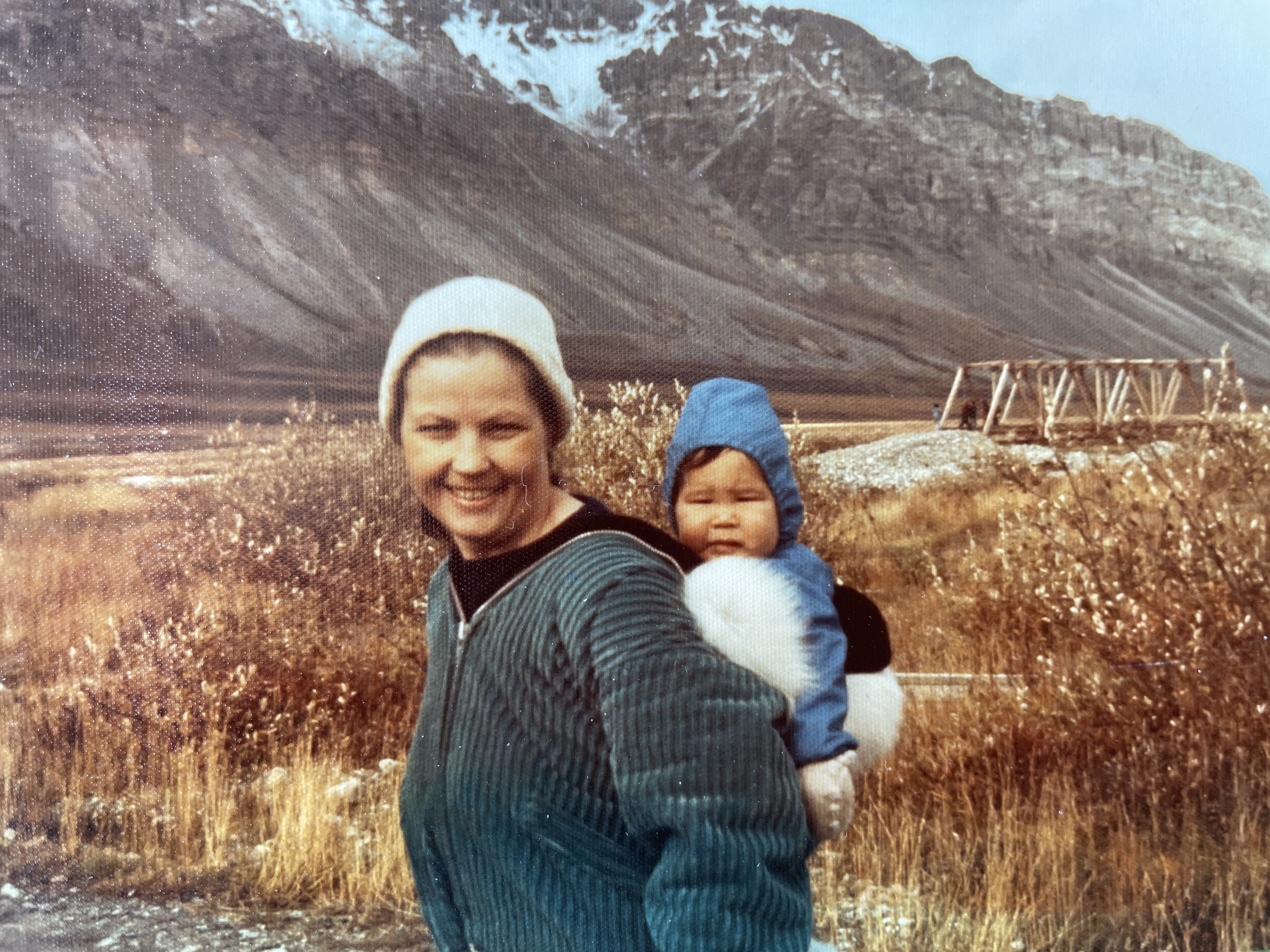
Caption Courtesy of Debbie Mekiana.
Caption Courtesy of Debbie Mekiana.
By Debbie Mekiana
Spring 2026, FORUM Magazine
I WAS BORN a half-breed. My father is Inupiaq from Anaktuvuk Pass, and my mother is a White woman from St. Paul, MN. Nowadays, I don’t think of myself as half Eskimo and half White anymore; an invisible line running vertically down my body with the dark red blood running through half my body and a lighter shade of red blood running through the other half of my body. I identify as Nunamiu, from my dad’s side.
Cultural identity has been a concept I have been conscious of daily in my life for half a century. When my dad passed away, I was nine years old. Mom could have packed us up and taken us back to Minnesota, where her midwestern White city/farm family lived. But she did not. I asked her when I was attending college, working on a bachelor’s degree, why she allowed us to stay at home. She told me she wanted my sister and me to know who we are and where we come from. That has meant the world to me as I grow and learn more about who I am and who I represent and who I am related to. I have witnessed so many young Native people unsure of their cultural identity because they were raised away from their Native families. We are so lucky that we were not taken or sent away.
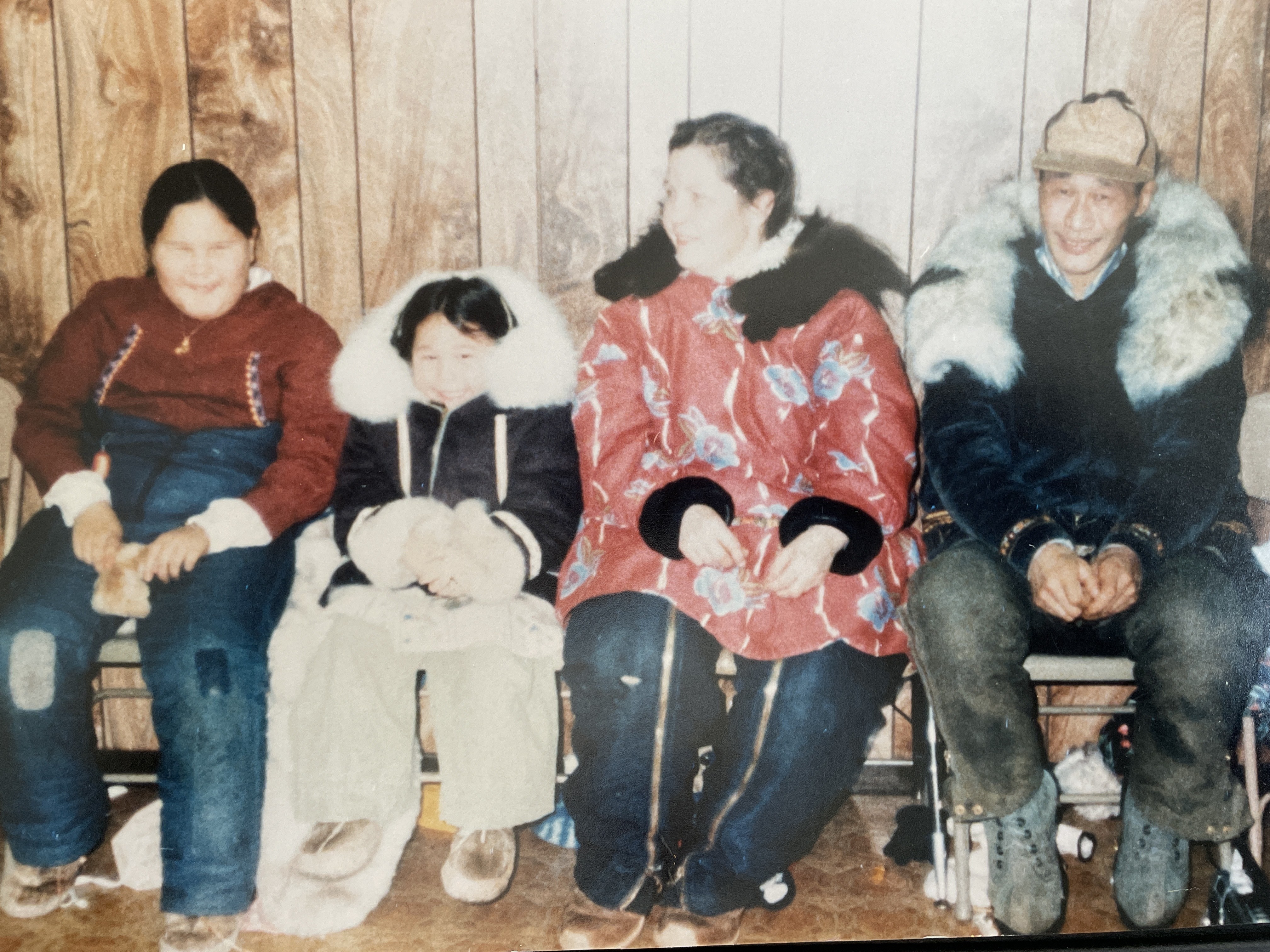
Caption Courtesy of Debbie Mekiana.
My generation was allowed to attend high school at home. We were not rounded up in the village and sent to a boarding school where atrocities happened. That was my dad’s generation. I attended high school at home, Nunamiut School - Home of the Amaguqs! Unfortunately, I was a very angry girl. I did not feel like I fit in anywhere. Our community is made up of seven families who decided to give up the nomadic life and settle. There were four of us cousins in my class. One of these cousins was also my best friend. She helped me navigate junior high and high school using humor to deflect racism and prejudice. She stood up for me when I was unable to stand up for myself. She reacted when I could not. Her parents were my Uncle and Auntie. Mom did not understand our Nunamiut kinship terms, so I did not call them Auntie and Uncle because they were not my dad’s siblings; they were his cousins. My Uncle was my dad’s best friend growing up. Their footsteps span the Brooks Range mountains from hunting, fishing, and trapping together as young men. They traveled with their dog team in winter or walked with their dog packs in the summer. A lifetime of experiences I can only see in my imagination.
I was practically living at my Aunt and Uncle's house during High School. I was there every minute of the day and slept at their house whenever I was allowed. As a single parent, Mom worked two jobs to meet our needs. She had been the postmaster for decades and taught GED classes in the evening at the school. She allowed me to be out of the house as long as it was school-related, so I got involved with the student council and student store. These activities kept me at the school for long hours. Many nights, I would walk home in the dark with the stars and moon as light. We did not have street lights. As my feet crunched on the frozen snow, halfway between the school and my home, there was a creek, and when we did not have a bridge, I would slide down the bank and climb the other side using the traction of my cool moon boots that mom was able to order from the Sears Roebuck catalog. I was hyper vigilant and aware of my surroundings. There could be a fox with rabies or wolves that would think I look delicious! It was a 10-minute walk, but for my over-imaginative brain, it was a daily test of survival! The wind and cold were not a factor. I was protected by my Eskimo jacket with a wolf ruff that my Mom learned to make from my dad’s mom.
She told me she wanted my sister and me to know who we are and where we come from. That has meant the world to me as I grow and learn more about who I am and who I represent and who I am related to.
At my Auntie and Uncle's house, I was just a kid. I could not just be a kid at home. I had responsibilities. I took care of my sister, who was four years younger than me. I cooked. I cleaned. I took out the trash and the infamous bucket of human waste that is now known as the honey bucket. I hauled water into the house after the water truck filled the eight 5-gallon buckets we set outside. I took the laundry to the laundromat every Friday. I cut the caribou meat that people would donate to us. The caribou meat provided meals that I prepared with canned vegetables and some sort of boxed side dish. I was able to accomplish all my chores because our teachers did not assign homework. It was exhausting, though. At the time, that was all I knew because the day my dad died, many of my relatives reminded me that I would have to be my mom’s helper. I had to help her, always. I think back and wonder if it is the idea of a fragile White woman in a rural Alaskan village that made my relatives insist I be her big helper.
I’m guessing the responsibility at home and the navigation of understanding bi-racial values ingrained my understanding of who I am; let’s say 90% dark red blood and 10% light red blood. I practice and live the values of my dad’s people. I practice humility as best I can, I teach my children that we share our blessings of food with others, and I love fiercely. To be Inupiaq is to love hard. There are many things I fail to teach my children, but my hope is that they will learn from their cousins, aunties, and uncles. Because, where I am from, the saying, “it takes a village to raise a child,” is not a metaphor; it is life. ■
Debbie Mekiana (2026 FORUM Storytelling Fellow) is a Nunamiu educator from Anaktuvuk Pass. Her work is rooted in the lands, languages, and stories of her people, and is guided by a deep responsibility to carry forward the knowledge of her ancestors. As a mother of three, her writing is shaped by both lived experience and a commitment to future generations, weaving together themes of identity, cultural continuity, and healing. Debbie’s storytelling centers Indigenous ways of knowing, exploring the complexities of family histories, intergenerational resilience, and the relationships between people, land, and language. Through her work, she creates space for truths that are often left unspoken, while honoring the strength and sovereignty of Alaska Native communities. In addition to her creative work, Debbie is an educator dedicated to culturally responsive learning and community-based knowledge sharing. She sees writing as both a personal and collective practice—one that can heal, connect, and sustain Indigenous futures.
FORUM is a publication of the Alaska Humanities Forum. FORUM aims to increase public understanding of and participation in the humanities. The views expressed by contributors are not necessarily those of the editorial staff or the Alaska Humanities Forum.
The Alaska Humanities Forum is a non-profit, non-partisan organization that designs and facilitates experiences to bridge distance and difference – programming that shares and preserves the stories of people and places across our vast state, and explores what it means to be Alaskan.
June 18, 2026 • Julian Ramirez
June 13, 2026 • Elizabeth Pantaleone
June 1, 2026 • Amanda Dale