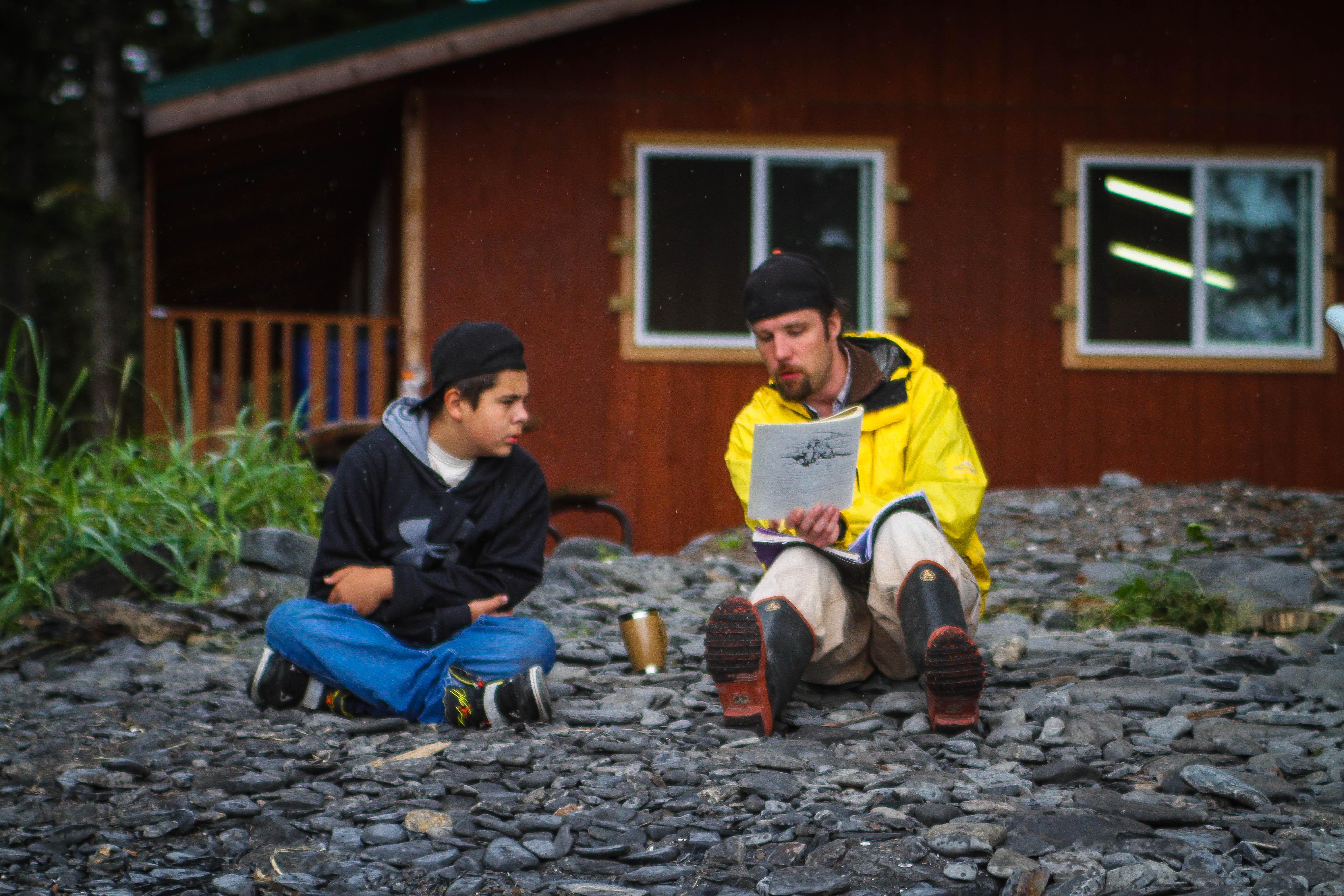
Adam Mackie (R) at DIG Afognak camp, summer 2016
Adam Mackie • October 19, 2026
My experience as a culturally responsive teacher and educator in Alaska was yet an origin story in the fall and spring of 2015-2016. I interviewed for the Alaska Humanities Forum’s Educator Cross-Cultural Immersion (ECCI) program, as I strove to teach high school English Language Arts (ELA) at West Anchorage High School with cultural reverence, sensitivity, and respect for all Indigenous people in Alaska. I felt honored to teach in my hometown of Anchorage, Alaska, land of the Dena’ina, and I welcomed the opportunity to expand my knowledge and awareness of Alaska. I gratefully accepted a position from ECCI to spend a week teaching at an Alaska Native culture camp on Afognak Island, home of the Alutiiq and Sugpiaq peoples, in the summer of 2016. It was a transformative time that shaped both my outlook on life and my teaching.
Adam Mackie (R) at DIG Afognak camp, summer 2016
After ECCI, I published an article in FORUM Magazine titled “Language of Survival” and offered my perspective on staying on Afognak during the culture camp. A decade and a pandemic later, I continue to integrate what I learned and designed during my ECCI journey through many classes and collaborations. In ECCI, I created a lesson called Culture Cards after becoming inspired to learn more about other people’s cultures. I discussed the Culture Cards activity in detail here, in conversation with the National Council of Teachers of English. I’ve shared this lesson not only with students, but also with other teachers, as an effective way to build authentic classroom communities. Benny Figgs, a fellow West Social Studies/ELA teacher, applied the Culture Card lesson in his classes. Benny said:
I appreciate how the Culture Cards activity allowed me to build connections with my students and learn about their background. Being able to introduce this assignment at the beginning of the school year was beneficial so that I could create positive relationships with my students. Students appreciated learning about their peers' backgrounds, and the cards allow students to feel seen and valued in the classroom.
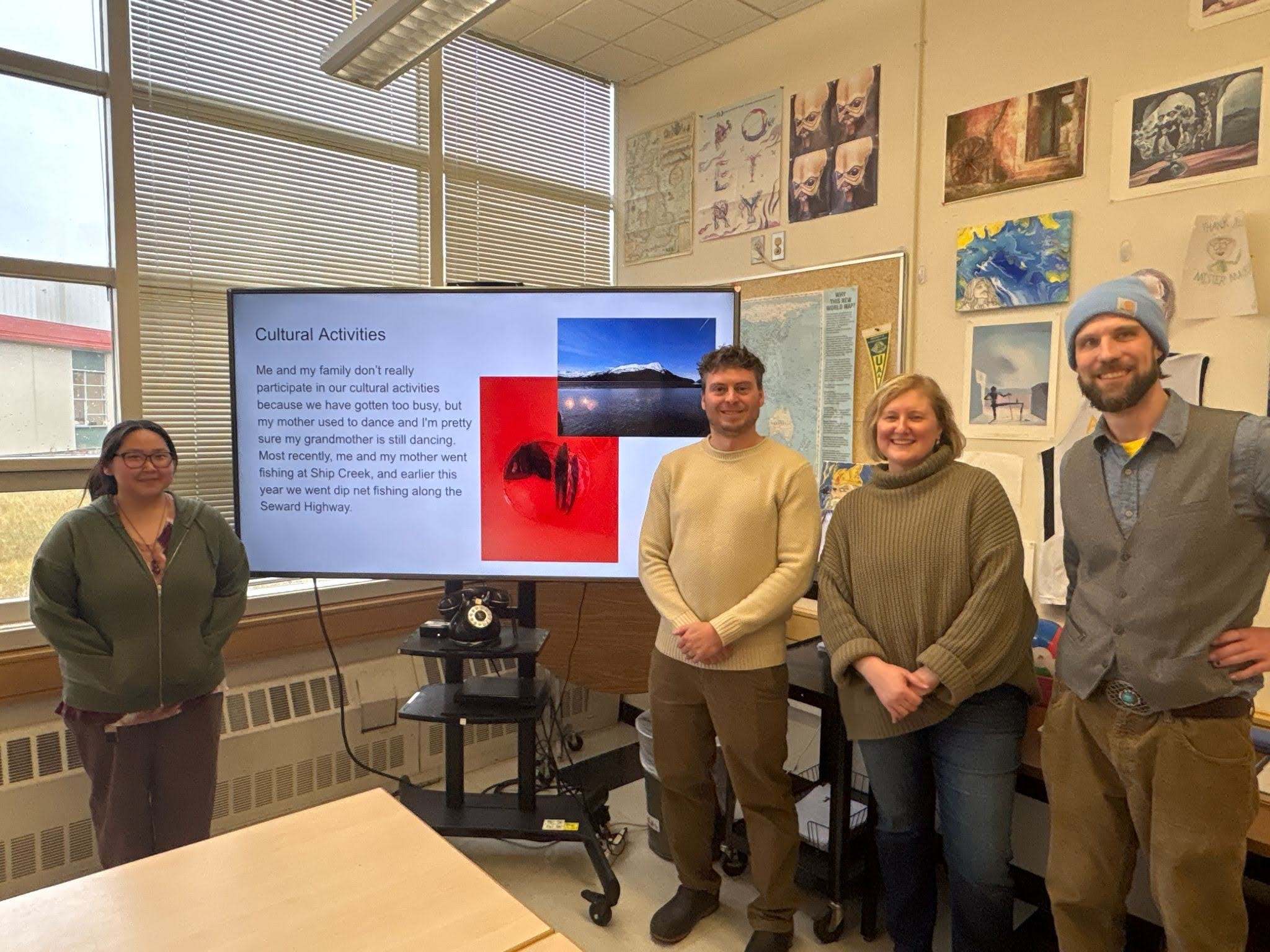
Misty Waskey, Benny Figgs, Rachel Kittoe & Adam Mackie (L-R)
West has amazing teachers. I am not the only teacher who has participated in ECCI at West. While I am honored and grateful to collaborate with others, I am fortunate to receive reciprocation from my extraordinary colleagues. Rachel Kittoe, English Department Chair at West, expressed how she uses an activity she designed during an earlier envisioning of the ECCI program, in addition to integrating my Culture Cards activity:
I use both the Culture Cards activity and an activity I designed back when I did Cross-Cultural Immersion and I went to Kake, AK for a week—the Culture Cards and my activity I think help students feel like their backgrounds are welcome to be shared in a school setting, and I think that's especially important considering the history of boarding schools in Alaska. I also love how students find out that they have things in common across cultures that they did not realize before—as Maya Angelou put it, "we are more alike, my friends, than we are unalike."
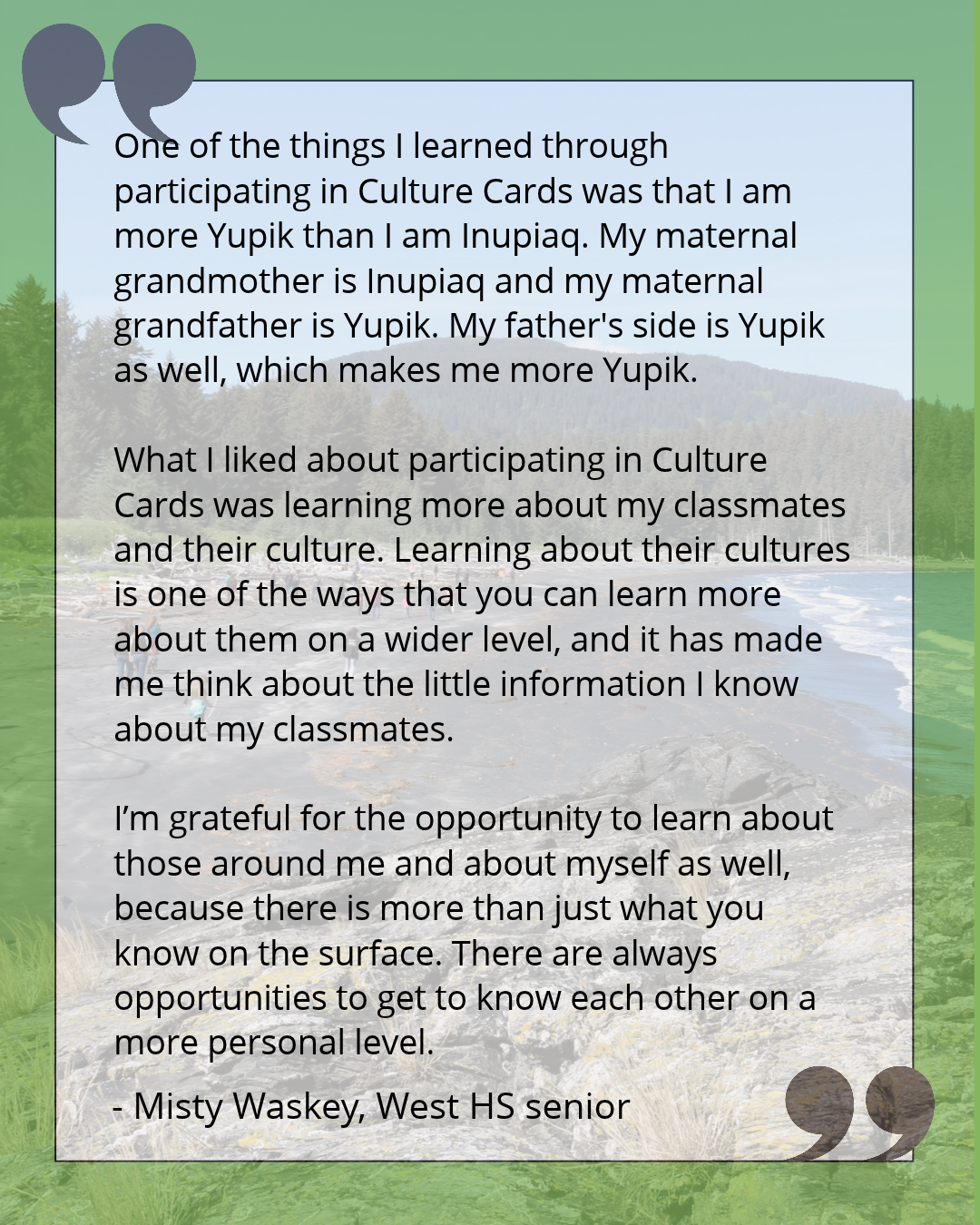
It has been a true gift to teach with Mr. Figgs and Ms. Kittoe at West, and witness our students making discoveries through cultural investigations. This year, Misty Waskey, a senior at West, presented her Culture Card to the class. Misty was born in Anchorage, but talked to the class about her Yup’ik and Inupiaq background, and how her mom’s side is from Nome and her dad’s side is from Bethel. After sharing her cultural affiliation, Misty talked about foods her family enjoys, including moose soup, Alaskan berries, akutuq ice cream, and a specialty breakfast of Spam, egg, and potatoes. Through authentic, personal sharing, Misty and her classmates begin to see each other as more than classmates, but part of something greater. Misty said:
Culture Cards help students throughout the course begin to see each other, and all people they encounter, as a “Human Family” and indeed “more alike… than unalike,” in the words of Maya Angelou and Ms. Kittoe. By modeling safe, vulnerable spaces and activities for public discourse, I hope students will carry these cultural conversations forward throughout their communities and feel empowered to confidently represent their diverse cultural realities in all contexts throughout their lives.
The Alaska Humanities Forum is a non-profit, non-partisan organization that designs and facilitates experiences to bridge distance and difference – programming that shares and preserves the stories of people and places across our vast state, and explores what it means to be Alaskan.
October 19, 2026 • Adam Mackie
September 21, 2026 • Taylor Strelevitz
August 27, 2026 • Eiden Pospisil
