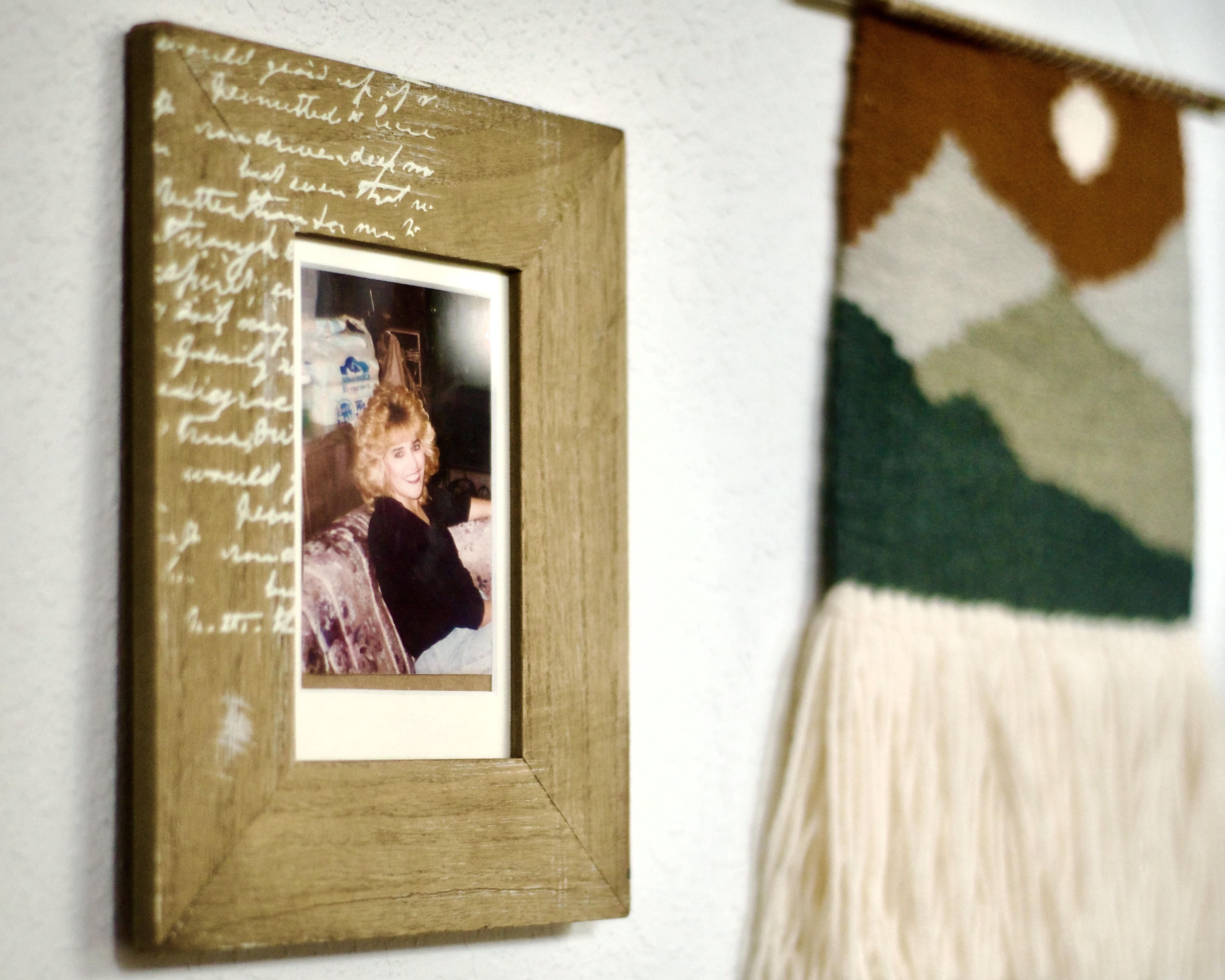
Photo of my mother, Maria Susana Alvarez, that hangs up in our living room. Photo credit: Elizabeth Pantaleone.
Photo of my mother, Maria Susana Alvarez, that hangs up in our living room. Photo credit: Elizabeth Pantaleone.
By Elizabeth Pantaleone
Spring 2026, FORUM Magazine
IN MY LIVING ROOM hangs a photo, it’s of my late mother, her black hair dyed blonde, shaped in perfect full curls. My mother, Maria Susana Alavarez, was murdered on March 7th, 1997, just two months shy of my first birthday. The photo of her that hangs in our living room is a 4x6, in a brown frame with the words “love” scribbled on it in white.
My mother was born, raised, and died in El Paso, Texas, but it wasn’t supposed to end that way. She had plans, as all mothers do, to make sure her children were safe. She was going to leave her husband and bring all five of her children to Alaska, where her younger sister was, thanks to her military spouse. It was supposed to be a chance for her to be free, to raise her daughters and only son, in a place where they’d have more opportunity. Although she never made it, her children did, but they weren’t raised together, and life definitely didn’t feel like an opportunity.
When I was younger, my extended family lived in apartments in East Anchorage. They were small, but at the time, they didn’t feel that way. I don’t remember much of our time there; most of it blends from one moment to another. The most vivid memory I had was the time my grandma was doing my cousin’s hair. I think in my mind, my grandma needed more light. I remember taking the lampshade off and moving it closer, but it ended up falling on me. The light bulb was so hot that it burned the side of my cheek. I would spend my entire childhood ashamed of a small mistake.
At some point, my aunt, her two kids, my older brother, and I moved from a two-bedroom apartment to a two-bedroom trailer. Again, it was small, but at the time, it didn’t feel that way. We lived in Manoog’s Isle next to the YMCA, where we spent most of our time. If it was winter, we’d beg my oldest cousin to take us swimming at the Y. The nights would be so dark and cold on our walks there, with yellow streetlights scattered along the road. During the summer, we’d ride our bikes with the other neighborhood kids to the soccer fields in the back of the building.
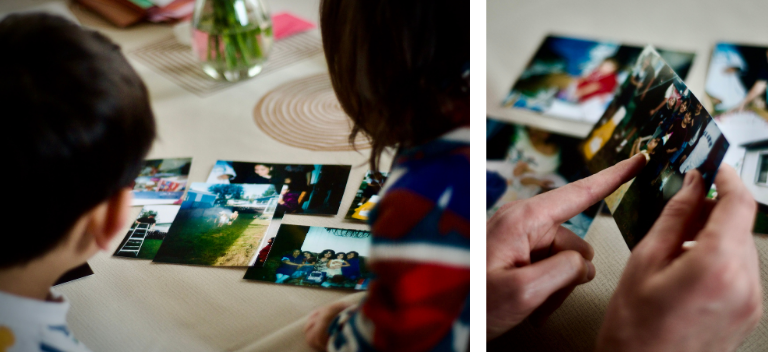
My husband and children looking through photos from my childhood, most of them taken at Manoog’s Isle. Photo credit: Elizabeth Pantaleone.
I would play on the jungle gym with my cousin and pretend we were at a restaurant. We’d fill our pockets with rocks as our currency. I remember one time I forgot to empty my pockets before laundry and could hear them rattling in the dryer, unaware of the damage I might have caused. I loved rocks when I was younger. I used to go to Campbell Creek and collect the ones I thought were “pretty.” They were usually shiny grey ones with hints of pink and white swirling around them, reminding me of the fish that would occasionally swim by my feet, making their way home.
I ended up learning that the fish that would swim by were silver salmon, something I didn’t know until I was almost in high school. See, our dinners were the standard TV tray style, and sustainability was not a value in my family, at least not for the women. Every camping trip, the men would make their way to the river in their waders with the fishing rod over their shoulder. The women would sit around the fire, with a Corona in hand and gossip to share. I always wanted to go fishing, but wasn’t allowed, and was okay with that because at some point the women would talk about my mother, their memories of her that they all held dear to their hearts, and for a moment it felt like I knew her.
I always wanted to go fishing, but wasn’t allowed, and was okay with that because at some point the women would talk about my mother, their memories of her that they all held dear to their hearts, and for a moment it felt like I knew her.
I think about that picture on my living wall, the woman in it who resembles me, my sisters, and my daughter. Her turned up lip and a smile that shows all her teeth, the same one I see in the mirror. I wouldn’t go fishing until I was in my mid-twenties.
I occasionally wonder if the life in Alaska I have lived, although not perfect, is the one she hoped for. The dreams of my childhood are clearer than my memories; I can almost smell the wet grass on a spring day when snow and mud mix. I can feel the cold from the year the snow was to my chest, but it was soft and easy to wade through to get to the snow mountain we would sled and snowboard down. Of course, it wasn’t a real mountain, and now as an adult, it probably wouldn’t have even been a huge hill, either, but it was fun, and we got hot cocoa at the end of it.
Maybe that’s all she wanted, was a simple, not perfect, but an alright childhood. One that she wasn’t able to have, one that she longed for, but was not in her cards. ■
Elizabeth Pantaleone (2026 FORUM Storytelling Fellow) is a life-long Alaskan, passionate about advocating for the increase of quality childcare and early childhood education in her community. She holds a Master of Science in Clinical Psychology and Graduate Certificate from the University of Alaska Anchorage. She holds a Bachelor of Arts in Psychology with minors in early childhood development and philosophy from Cal Poly Humboldt (formally Humboldt State University). Elizabeth is currently an Early HeadStart Coach, supporting teachers in strengthening instructional practices through Conscious Discipline training and CLASS observations. Elizabeth started a personal photography project Dember 2025 entitled "Through Their Eyes: Alaska" focusing on the untold stories of Anchorage's childcare crises through interviews accompanied by portraits. Through this writing fellowship, Elizabeth aims to highlight the successes and challenges of early childhood education in Alaska. Raising awareness about the essential role early childhood care and education plays in Alaska's economy, the struggles educators and families are facing and a look forward in search for hope.
FORUM is a publication of the Alaska Humanities Forum. FORUM aims to increase public understanding of and participation in the humanities. The views expressed by contributors are not necessarily those of the editorial staff or the Alaska Humanities Forum.
The Alaska Humanities Forum is a non-profit, non-partisan organization that designs and facilitates experiences to bridge distance and difference – programming that shares and preserves the stories of people and places across our vast state, and explores what it means to be Alaskan.

September 21, 2026 • Taylor Strelevitz
August 27, 2026 • Eiden Pospisil
July 24, 2026 • Annie Garay