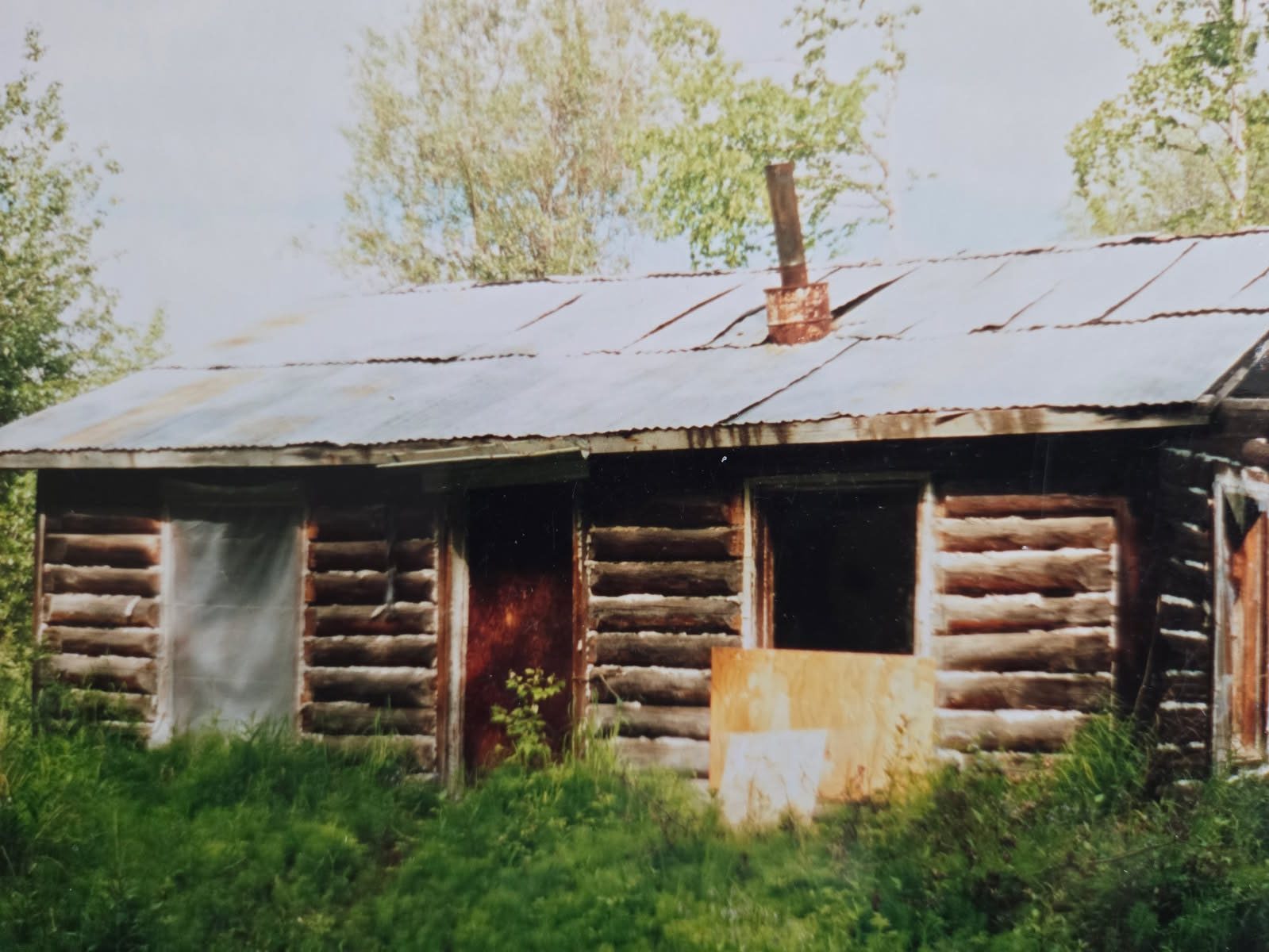
Titus family's Old Minto home. Photo courtesy of Irene Sherry.
Titus family's Old Minto home. Photo courtesy of Irene Sherry.
By Irene Sherry
Spring 2026, FORUM Magazine
TODAY, MY HUSBAND, SON, and I hauled our boat to the landing in Nenana, south of Fairbanks. We travelled for an hour down the silty, fast-moving Tanana River to Old Minto, where I grew up.
No one was there. Seventy years ago, there were 40 homes, our school, and our store. Now the whole village is overgrown with willows over your head, and few structures are still standing. All around are butterflies, bees, mosquitoes, wasps, and dragonflies.
I made my way up to the old trail to the log home I was raised in, built by my father, Walter Titus, in the 1930s. It is one of the few homes still standing. The lumber floor is failing, the windows are gone, but the wood and sod roof remains. Our old outhouse and cache have fallen into the grass. There are old graves nearby.
As I sat in the house in silence, the memories of my childhood flooded over me.
I lived with my parents, three older brothers, and my older sister. My dad was a hunter, fisherman, trapper, and seasonal railroad worker. My mom was a homemaker, a gardener, a seamstress, and a jam maker.
In the early winter, we gathered a lot of wood. My job was to give water to our dogs, hook up the sled, and take them across the wide frozen river to our woodyard, load up the sled, and take it back to the village.
In the winter, the temperatures went down to fifty below zero. Late at night, I would lie in bed, with one of our dogs at my foot, watching the firelight flicker and dance on our cabin's ceiling, listening to the wind as it whispered and sang against the small window by our cozy bed.
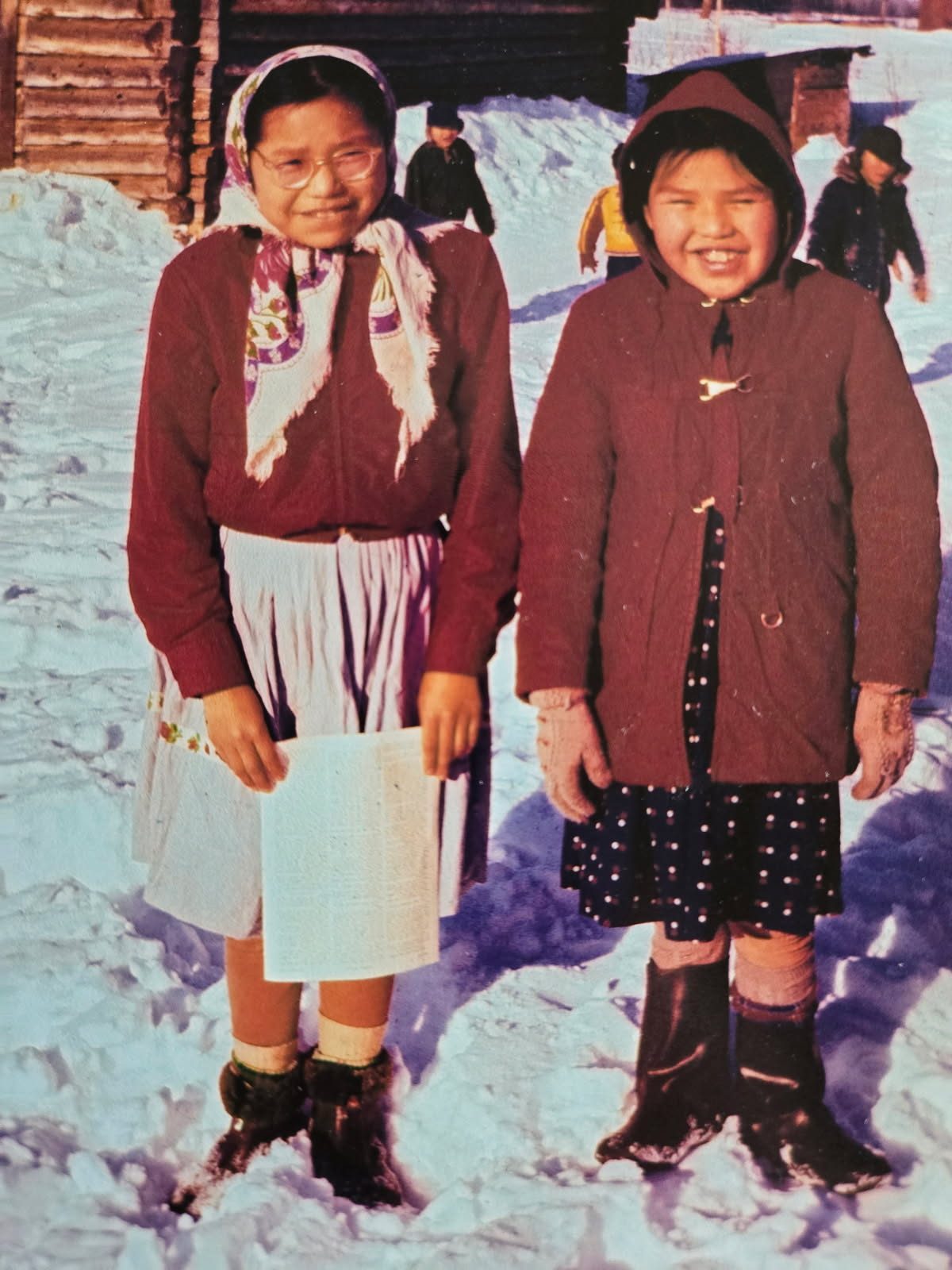
My sister Terri and I. Photo courtesy of Irene Sherry.
My grandma and uncle lived next door, and sometimes I slept with Grandma on the floor, with a caribou skin mattress, goose down pillows, and a rabbit skin blanket.
Sometimes we would listen to the radio. And I would sing. That’s how I got my name. “Shru’,” which means “Robin”. My grandma gave me that name.
Sometimes the elders would get together and tell old-time stories, mostly in our Athabascan language. I would sit in the corner in my patch quilt, then lie down and listen to the voices of the women as they spoke and sang some songs. “Whutlonda, whutlonda, yoko guyanho tinotlee”. I watched the gas lamp overhead.
I remember my Uncle making us a warm breakfast. My sister and I walked to the Bureau of Indian Affairs (BIA) school. We dressed warmly, with homemade moose skin boots, woolen knitted socks, fur parka, rabbit skin foot wraps, fur hat, and mittens.
These stories need to be told to our children and our grandchildren. So they know about the land and people they came from.
It was dark on the walk in the morning, and dark when we came home. There were times when the moonlight was so bright that we kids played our favorite game called shadow tag.
Every Saturday, our chore was to haul water from the river, in big buckets on our sled, from a hole in the ice. We heated the water on the stove, filled up the galvanized tub, took a bath, and got ready for Church on Sunday morning.
Church was a big part of our lives. Some days, the Episcopal Bishop visited. We had Sunday School at the Assembly of God mission.
My patch quilt was made from the men’s suit jackets that my mom got from the church rummage sale. In the summer, the church sent big barrels of clothes on the steamboat, and it was exciting for the whole village. The Women’s Club put out all the clothing. They said a prayer and gave thanks, and then everyone rushed to find what they could use. Mom made pillow cases, curtains, and dresses from those barrels.
One time, all the women were asked to the parish hall to see the first sewing machine someone brought in. All the old ladies were scared of the noises it made. After Auntie Evelyn started it up, everybody wanted one.
These memories are still real all these years later. These stories need to be told to our children and our grandchildren. So they know about the land and people they came from.
I carry them with me, back up the river, to share wherever I can, with my family, friends, and you. ■
Irene Sherry (2026 FORUM Storytelling Fellow) is an Athabascan woman from the village of Minto Alaska. She is a wife, mother, grandmother, boarding school survivor, film producer, counselor, student mentor, and prayer warrior.
FORUM is a publication of the Alaska Humanities Forum. FORUM aims to increase public understanding of and participation in the humanities. The views expressed by contributors are not necessarily those of the editorial staff or the Alaska Humanities Forum.
The Alaska Humanities Forum is a non-profit, non-partisan organization that designs and facilitates experiences to bridge distance and difference – programming that shares and preserves the stories of people and places across our vast state, and explores what it means to be Alaskan.

July 24, 2026 • Annie Garay
July 23, 2026 • Taylor Strelevitz & Polly Carr
July 17, 2026 • Polly Carr