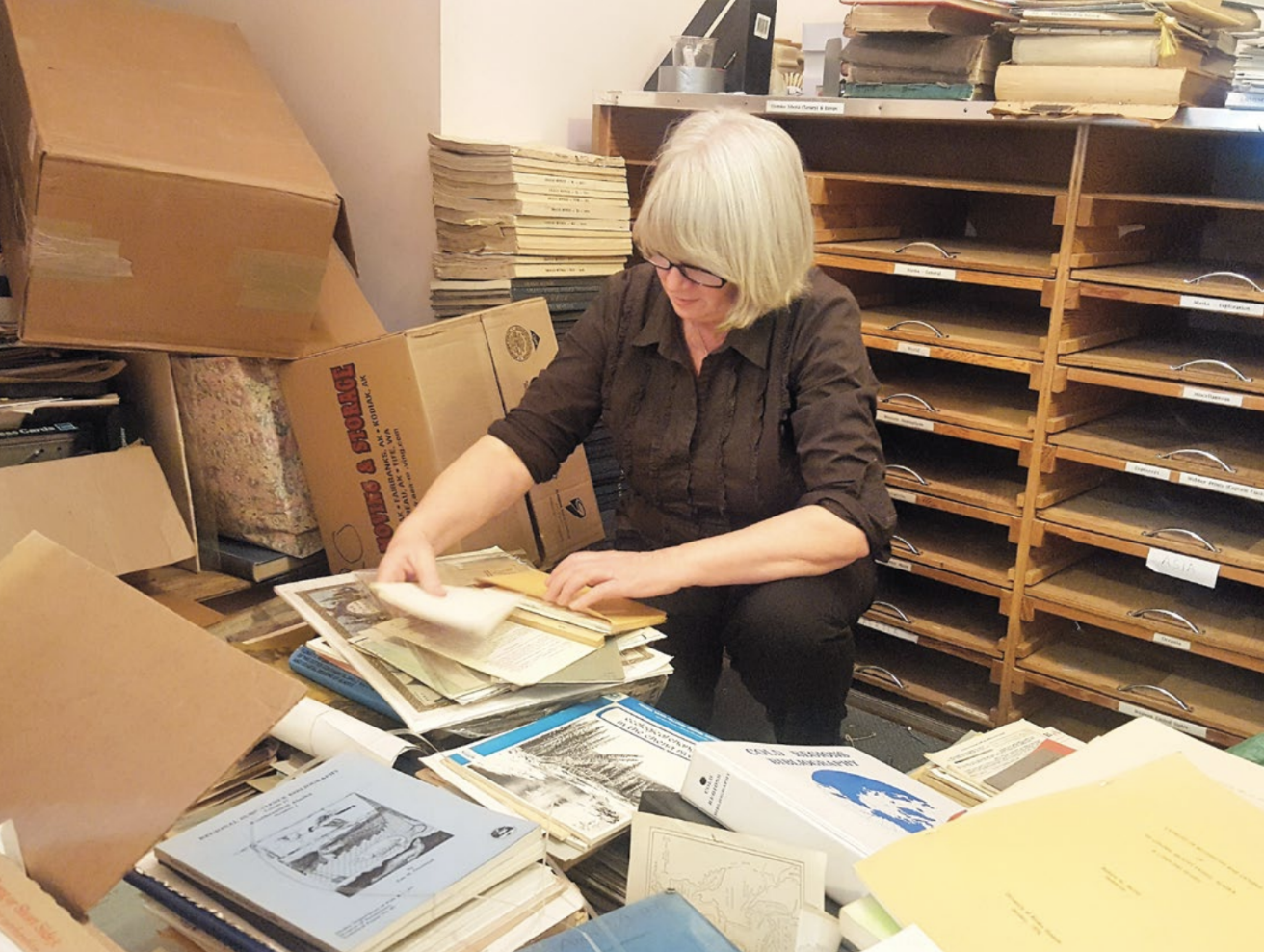
Author Patti David examines documents while working on the liquidation of Observatory Books. The bookstore was renowned for its collection of Alaska historical sources, among much else. Photo by Liz Kellar / Juneau Empire
Author Patti David examines documents while working on the liquidation of Observatory Books. The bookstore was renowned for its collection of Alaska historical sources, among much else. Photo by Liz Kellar / Juneau Empire
By Patti David
Spring 2018, FORUM Magazine
TWELVE YEARS AGO, I made the pilgrimage up Juneau’s Franklin Street to Observatory Books, as many had done before me. Like all bibliophiles, readers, and history buffs, my book radar constantly pinged, and Observatory Books—purveyor of used, rare, and vintage volumes, among much else—returned a strong echo. I lived in Sitka then, and during my research on the Jewish
history of the American West, I discovered a thread to pull: a tidbit of information I thought might become a quirky footnote to Alaska’s Jewish history. I wanted to be the one who noted it, so I boarded the overnight ferry for Juneau with my sights set on the well-known bookstore.
The object of my quest was the “Teichmann Diary,” also known by its official title, A Journey to Alaska in the Year 1868: Being a Diary of the Late Emil Teichmann. An edition of 100 was published in 1925, and a reprint of 750 was issued in 1963. Teichmann visited Sitka as a representative of a fur company during the feverish boom that followed the transfer of Alaska from Russia to the U.S. The diary reveals him to be the spoiled son of a rich man, prudishly critical of the rough and rowdy outpost that Sitka was at that time. Most noteworthy, the book contains the first published description of Jewish people in Alaska.
Upon my arrival in Juneau, I climbed up Franklin Street and entered the dark old store, then stumbled over a Golden Retriever spread across the only empty floor space. As my vision adjusted, I said hello, and a friendly voice answered. Behind a huge old desk, a tiny, birdlike woman smiled and said, “How can I help you?” It was Dee Longenbaugh, proprietor.
I launched into a sing-songy narrative about the history of the Teichmann Diary. When I concluded, she simply said, “I have two copies, and I will sell one of them.”
She got up, disappeared into the stacks, and in five seconds flat she returned and handed me the volume: $90.
“Wow, my goodness, thanks,” I said, gobsmacked. That seemed far too easy.
“My copy is in the original binding, but I don’t want to sell it,” Dee explained. “This one is rebound, the only other one. Now, sit and tell me about yourself and what you are doing in Sitka.”
This was my first taste of Dee’s erudite personality and steel-trap memory for historical information. As she and I sat and chatted, the bright noonday waned. I departed into dusk, mentally whipped after discussing everything from the North Pacific voyages of the French to Ernest Gruening’s participation in the establishment of Israel.
I had no idea that afternoon that twelve long years later that I would return to Observatory Books, this time to liquidate the historic institution after Dee, rather suddenly, lost most of her eyesight and closed the shop.
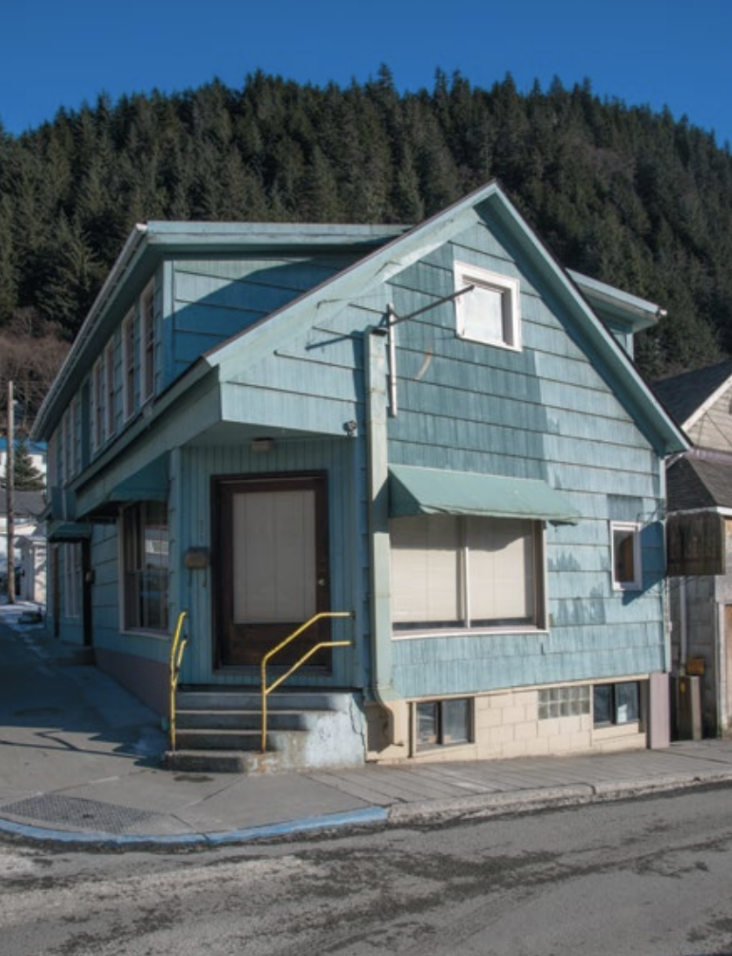
The store’s former premises in Juneau are presently vacant. David established a “free library”
under the awnings to distribute some of the store’s stock. Photo by Ben Huff
The day I arrived to begin dismantling the bookshop, I set my coffee down and stood in silence. No point in saying hello this time; I was alone. It was not so much a silence as an absence of something. Dee’s wool sweater was still wrapped around the shoulders of her chair. Her coffee mug rested on the old desk.
Since my encounter with Dee over the Teichmann Diary, I had broadened my work to include handling dispositions of private libraries and estate art. When the Juneau writer and poet Marylou Spartz informed me that the store had been closed for nine months, I inquired about the fate of the materials. Soon after, Dee’s family contracted me to facilitate the liquidation.
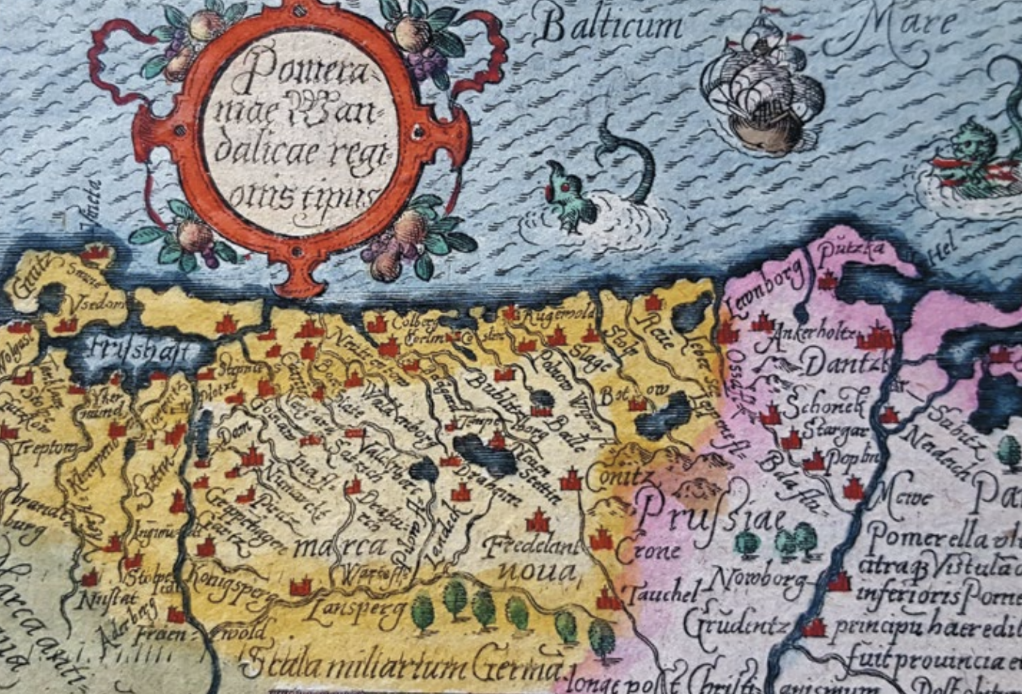
The first days were almost like shopping. I sat and looked intently at books piled everywhere. For forty years—first in Sitka, finally in Juneau—Dee had been collecting and dealing in books. Buried under the layers was an astonishing conglomeration of great stuff: about 30,000 books, 20,000 pieces of ephemera, and 500 maps. The place was a labyrinth of bookcases protruding into
rooms. Nobody ever got as much out of the square footage of a retail space as Dee Longenbaugh did at Observatory Books, that’s for sure. A thick layer of gray dust coated books, shelf edges, Dee’s sweater, even the walls. I coughed constantly. The Taku winds swept in a fine silt in the months the shop was closed.
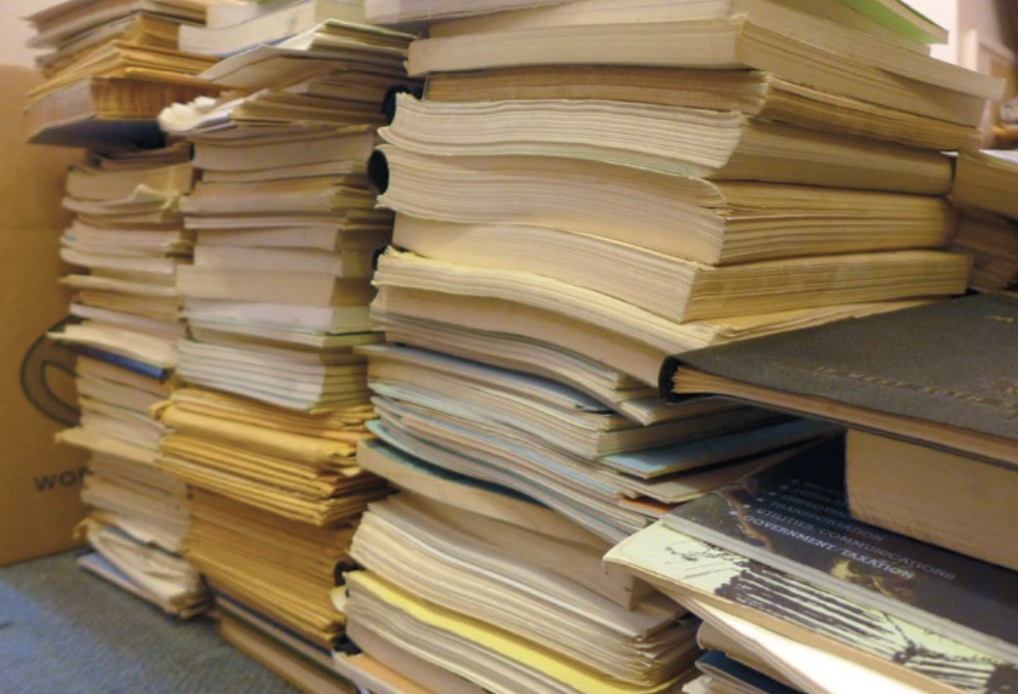
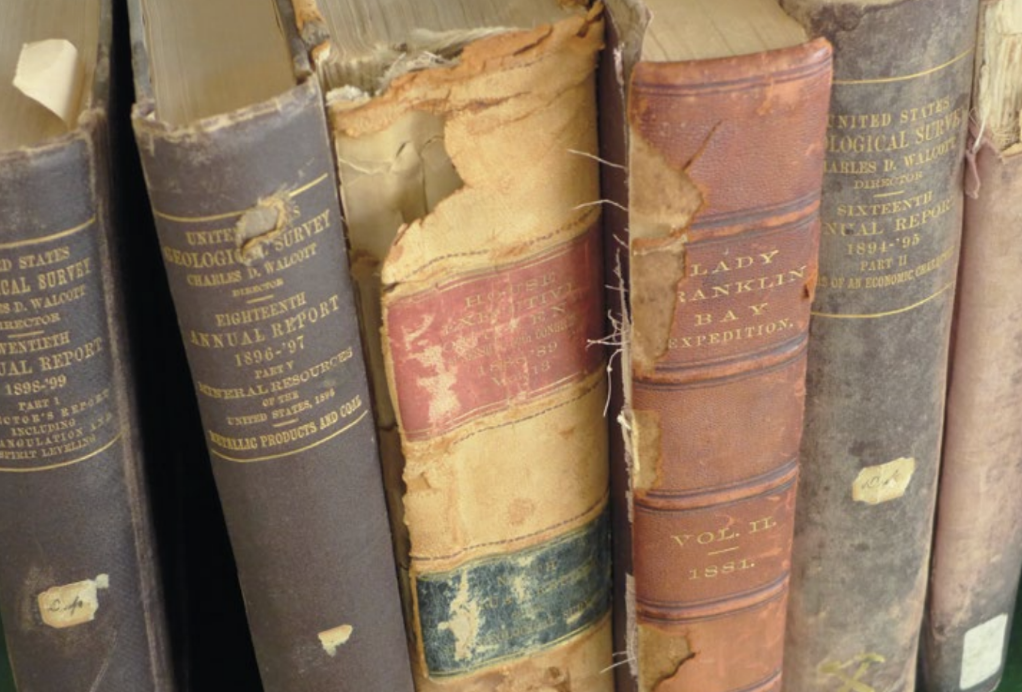
When it closed, Observatory Books contained about 30,000 books, 20,000 pieces of ephemera, and 500 maps. Most of the valuable Alaska historical materials found new homes in local institutions. Photo by Joel Bennett
I penciled out a plan of attack: first get rid of junk and clutter, then assess each bookshelf. It was not just a matter of organizing books—it was a major cleaning job, then organizing the books. The bookcases were loaded, and atop them more books were stacked toward the ceiling. Books were piled haphazardly on the floor, in front of the desk, along the walls, and across parts of the maze.
The back doorway of the shop was blocked by a solid wall of huge, old legislative manuals and dozens of text books. They had been stacked there purposely, to provide security against a druggie who kept breaking in the door to steal petty cash. Along with three fake cameras, this stack of books was the store’s security apparatus. Their removal uncovered four valuable travel books—missing for a decade—with pristine maps inside. (Another such find was when I picked up two fairly recent magazines and something fell from between them. It appeared to be a small invitation envelope and, thinking I would place it with Dee’s personal papers, I discovered it was a 1950 Christmas card from Robert Frost.)
The locals passing by had quit glancing in the windows months ago. They did not seem to notice the lights were on for a change. I came and went many times before anybody said anything. I spent weeks behind papered windows, sorting, organizing, and making calls. When springtime brought a rare sunny day to Juneau, the blocked door was prioritized, unblocked, and swung open. Fresh Tongass breezes scoured out some of the dust, and the job took a new turn as my solitary sorting inside was over.
I began setting obsolete and low-value volumes outside, along the window ledges under the awnings. People stopped and we chatted on the sidewalk as I stocked this free library and padded in and out the back with armloads of books. For weeks it was just locals, then locals and tourists. Pilots, cruise-ship crews, tourists on return trips—each arrived at the doorway, read the “store closed” sign, then looked up the sidewalk and noticed me. “It’s closed?” they asked. “Unbelievable.”
When she had been there, Dee held court at her desk. I was drawn to the sidewalk, because once the doors were open, the community came by to say hello. I met people from all walks of life; Dee had been an occasional source of income for several street people who sold books to her and it took some finesse to reset their expectation levels to zero. I found over the months that sidewalks are a more equitable place to solve political issues than a legislature or a bar; the sidewalk next to a bookstore welcomes every opinion, from every flavor of human being. My time on the sidewalk can be viewed as a series of short scripts—characters move in and out of the frame, pausing to tell stories of how they met Dee, or how they came to Juneau, or what they think of Trump, or the ferry system. And they often asked: “Will the important Alaska stuff Dee had stay in Alaska? Maybe go to the State Museum?”
For many weeks I trekked to the shop, unlocked the heavy glass and oak door, and faced the same question: what would become of the books? The maps and ephemera? The rare and valuable and the almost worthless?
Each bookcase held a very wide range of values; treasures were shelved next to books I literally could not give away. A rare copy of a volume by Harriet Beecher Stowe was crammed between Watergate bios. I was not selling retail, but rather wholesale, since this was a liquidation—and in Juneau, at that. The job required sorting by value: books not worth the price of shipment, to be distributed locally; books worth shipment in bulk, to be sold at retail Outside; and books worth special attention for their value to historians and collectors.
One primary goal was to send as little as possible to the landfill. This pledge, carried out through the dedication of one volunteer, Trish Beckwith, resulted in less than half a garbage can of trash ending up at the dump. For weeks, the free library outside the store was continually refreshed. It was a pleasure to watch folks excitedly find a good read. Many books went right into homes that could not afford to buy books at any price. When the books were gone, we dragged the old particle-board bookcases to the curb; people came back and carried those away, too.
The bulk of the nice volumes worth less than $5 were donated to the Amazing Bookstore, run by the Friends of the Juneau Public Library. The spinning paperback racks at the senior center, Bartlett Regional Hospital, ferry terminal, and Glory Hole Shelter and Soup Kitchen reaped a couple of fill-ups. The balance of the better books and the maps will be offered for sale through Andrew Langer Books in Berkeley, California.
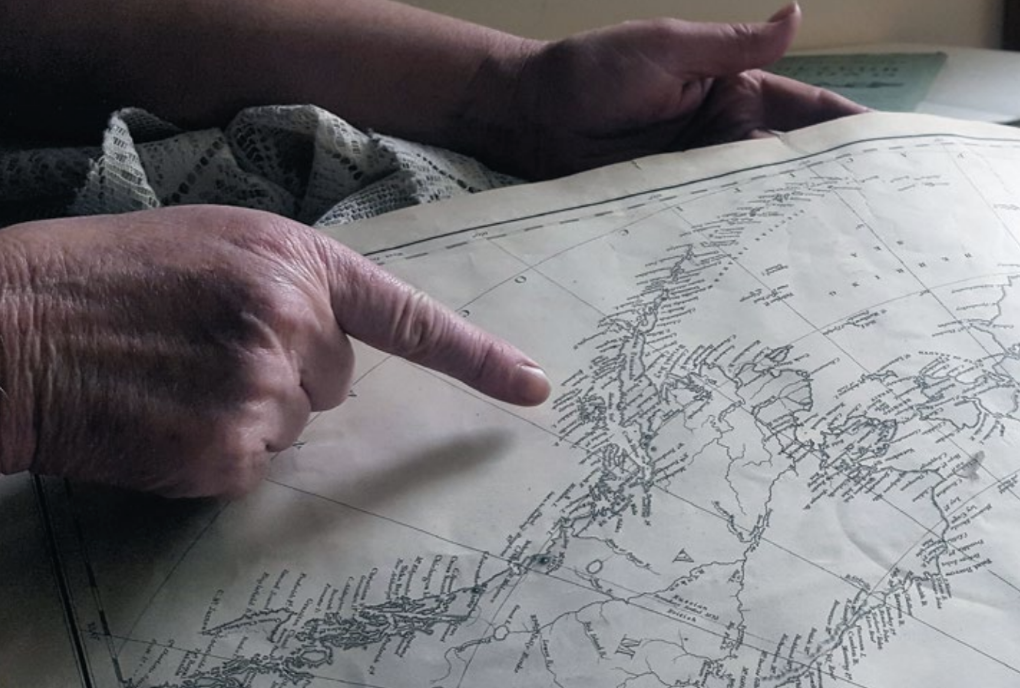
Dee’s renowned Russian-America collection came into play after a major collector declined to take it. This was a true blessing for the people of Alaska. Museums were invited to look over the materials. Hundreds of books, documents, ephemera, journals, and maps are today part of the collections of the Alaska State Museum, Sealaska Heritage Institute, and Juneau-Douglas City Museum. Among the materials are copies of President Andrew Johnson’s 1868 welcome to Alaska’s formerly-Russian residents, in which he advised them on how to interact with their new government, who was in command, how laws were made, and the benefits they would enjoy as citizens of the United States. Other treasures include original inaugural speech notes by Gov. William Egan; a cookbook from a 1901 Nome gold camp; and rare chapbooks by John Haines, the late Fairbanks poet. And despite a robbery two years ago, when dozens of maps were lost, there were many others, including early maps of Alaska, that were given to the State Museum to consider.
Dee Longenbaugh’s impatient curiosity about Alaska led to her distinguished collection, now happily the property of the people of Alaska. This is perhaps the greatest legacy of Observatory Books.
The sidewalk next to a bookstore welcomes every opinion, from every flavor of human being.
The day i finished the job at the bookstore, I sat in the empty, echoing space in the late afternoon light of September. The books were gone, the walls bare of bookcases, and people passed by without looking in, just as on that first morning. After a summer of conversations, the corner grew quiet as the last cartons were lugged out and trucked away. Next year, visitors will find no one to counsel them about the old bookstore and their memories of Dee.
The corner shop, too, has been returned to the community. For now, it’s empty. The shop had been a neighborhood market, a small political press, and a pizza joint before it was the bookstore. There’s a bakery in the basement; in fact, it is likely the books and ephemera upstairs survived the wet Juneau climate because the baker’s ovens dried the air rising through the floorboards. It seems remarkable only one shelf held moldy books.
That last day, I stood there thinking: There was a time I lived with many books. These days I keep just a few, preferring to save my limited wall space for art, I suppose. Of all the books I could have chosen from the store, I kept not one. I even donated my copy of the Teichmann Diary to the Sitka Historical Museum.
Yet, a bookshop will always glow within my heart because of Observatory Books. So I do have books, after all. ■
Postscript: Dee Longenbough passed away on February 9, 2018, in Juneau.
Patti David wrote about the artist Alfred Skondovitch in the Spring 2014 issue of FORUM. She also writes about her life in Alaska. She may be contacted at reachpattidavid@gmail.com.
FORUM is a publication of the Alaska Humanities Forum. FORUM aims to increase public understanding of and participation in the humanities. The views expressed by contributors are not necessarily those of the editorial staff or the Alaska Humanities Forum.
The Alaska Humanities Forum is a non-profit, non-partisan organization that designs and facilitates experiences to bridge distance and difference – programming that shares and preserves the stories of people and places across our vast state, and explores what it means to be Alaskan.

July 24, 2026 • Annie Garay
July 23, 2026 • Taylor Strelevitz & Polly Carr
July 17, 2026 • Polly Carr