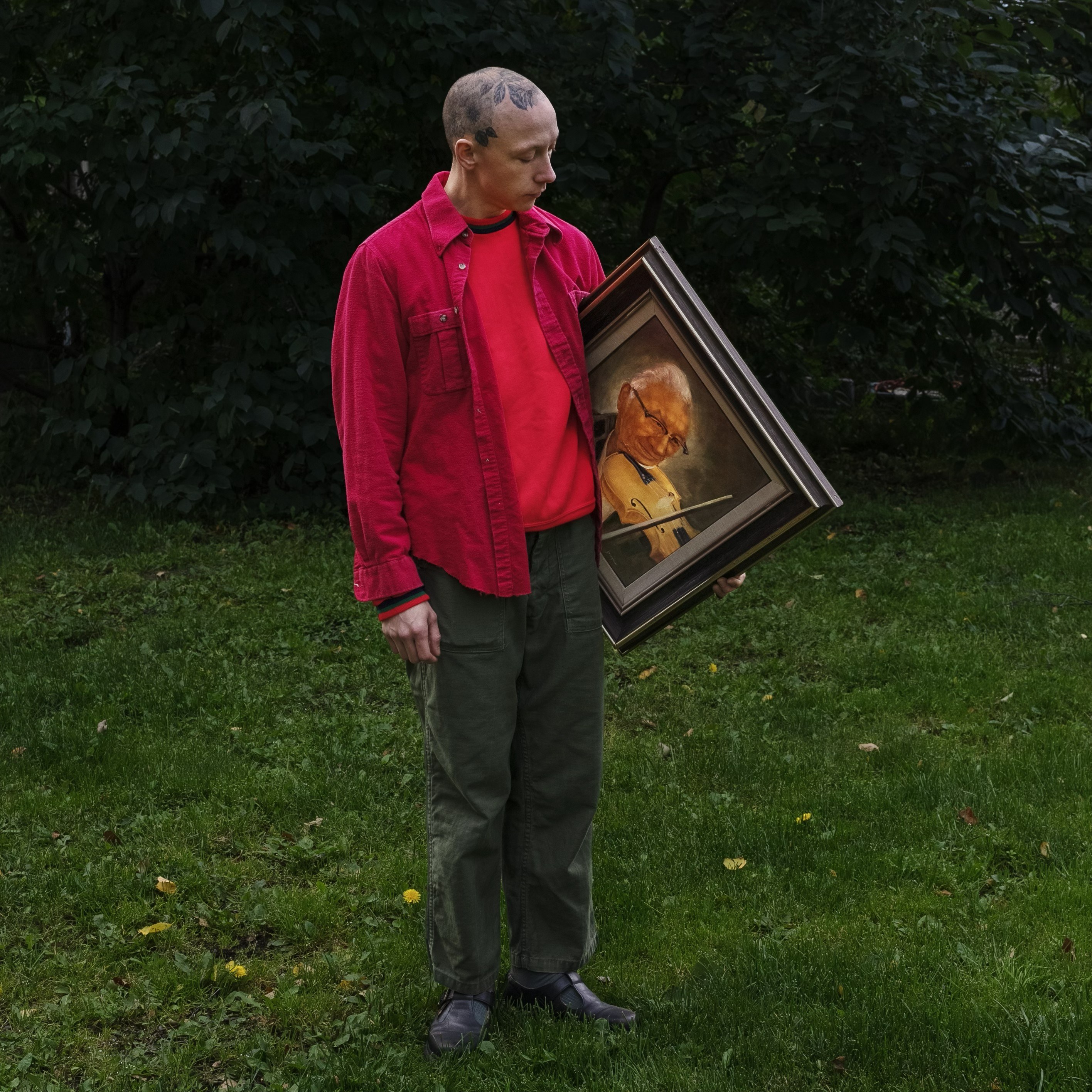
Holding the painting of my great-grandfather, Frank Hobson. Photo by Emma Sheffer.
Holding the painting of my great-grandfather, Frank Hobson. Photo by Emma Sheffer.
By Quinn Christopherson
Spring 2026, FORUM Magazine
THINGS HAVE BEEN finding their way back to me. Not because I knew they were missing, but because, somehow, they knew where they needed to be.
My mother is Tawny LeBlanc. My grandmother is Mary Alee Hobson. My great-grandfather is Frank Hobson.
Frank Hobson was known as The Eskimo Violinmaker. He made over fifty violins, along with cellos, violas, and guitars. He started by cutting down the tree. He once said, “A block of wood has a tone to it. I rub my hands over it after it is cured to see if the wood is alive. If it isn’t, there’s no point in going further with it.” I think about that now, what it means for something to be alive.
It started with a painting.
An older couple messaged me on Instagram after I spoke about my great-grandfather in an essay published by Atwood Magazine. They said they had something that belonged to my family. It had been seven years since my grandma Mary passed. In her house, there was a painting of her dad that never moved. The kind of piece that becomes part of the room. I hadn’t seen it in years.
I was driving out of town with a couple of friends, headed to a stranger’s house because they said they had something that belonged to me. They welcomed us in like we knew each other. They were excited. And there it was, leaning against the wall. I knew that painting immediately. A portrait of an older man holding a violin under his chin. My great-grandfather.
He has white hair, Ray-Ban style glasses and a plaid jacket. He looks proud. In a quiet way. The violin rests under his chin like it belongs there. He made it. He died before I was born, but in that painting he feels alive.
It felt like my grandma’s house. I could taste the sugar cubes. I could hear her voice, the way she would tell stories about her dad whenever she caught that painting in her line of sight. She was fond of him. I was fond of her.
“Memory” is a song created by Quinn Christopherson in collaboration with Aywaa Storyhouse, featuring Heidi Senungetuk playing Frank Hobson’s violin, Melissa Shaginoff drumming, Kevin Worrell on stand-up bass and guitar, and Brian Dekker on keys, production, and composition.
The couple told me they found it at a thrift store for twenty dollars. They could tell it mattered. On the back, it said “Frank Hobson, Eskimo Violinmaker.” They tried to find family but nothing came up until years later when they saw me.
That painting made its way back to me because I spoke about him. Because I remembered.
I grew up hearing about my great grandfather’s violins, but I had never seen one. I grew up hearing how he could play anything with strings. Stories about jam nights at his house, people coming in from villages all over, filling the house with music. I heard how he was a tinkerer, how he got his first violin, took it apart, and thought, I can do that. I needed to hear one.
A friend told me there was a Frank Hobson violin up for auction one weekend. I showed up in a moose hide vest that my sister Raedeen gave me. My grandma’s moccasins. Plaid trousers, and a black tie. I didn’t know how auctions worked. I just knew I needed that violin.
I sat at a table with strangers and told them why I was there. About my great-grandfather. They listened. And then they said, “You’re going home with that violin tonight.”
That painting made its way back to me because I spoke about him. Because I remembered.
It was the last item in the auction. Everything before it made me more nervous. Pieces were going for tens of thousands of dollars. When the violin came up, the bidding started at $1500. I raised my paddle. So did a lot of other people. Before the auctioneer could continue, the people at my table shouted, “That’s his grandson!” The room shifted.
The auctioneer repeated it into the microphone. Some people backed off. $1600. $1700. $1800. Every time I raised my paddle, my table shouted it again. “Grandson!”
I didn’t expect that kind of support. Not in a room like that. At $1950, someone at my table leaned over and said, “Let me win it for you.” She raised her paddle. $2000. And just like that, it was over. We won. We went to the bar next door and we danced and laughed and celebrated like we had known each other for years.
But what stays with me isn’t the win. It’s the way things returned. A painting I hadn’t seen in years, waiting in a thrift store until someone saw that it mattered. A violin coming to me right when I was ready to reach for it. I think about what my great-grandfather said, how you can feel if something is alive.
I think about that painting and that violin. And how they came back. ■
Quinn Christopherson (2026 FORUM Storytelling Fellow) is an Ahtna and Inupiaq songwriter from Anchorage, Alaska. He won NPR’s Tiny Desk Contest in 2019 and has since toured across the U.S. and Canada. His debut album, Write Your Name in Pink (2022), blends honest storytelling with bold sound. Most recently, Quinn co-wrote Portugal. The Man’s song “Denali.”
FORUM is a publication of the Alaska Humanities Forum. FORUM aims to increase public understanding of and participation in the humanities. The views expressed by contributors are not necessarily those of the editorial staff or the Alaska Humanities Forum.
The Alaska Humanities Forum is a non-profit, non-partisan organization that designs and facilitates experiences to bridge distance and difference – programming that shares and preserves the stories of people and places across our vast state, and explores what it means to be Alaskan.

October 19, 2026 • Adam Mackie
September 21, 2026 • Taylor Strelevitz
August 27, 2026 • Eiden Pospisil