Por / By Gabriela Olmos
Spring 2022, FORUM Magazine
THE STORY OF OUR LADY GUADALUPE
AN INDIGENOUS Mexican young man experienced a miracle on December 12, 1531. He was poor and felt that dignitaries often set brown people like him aside. But he learned that people forgotten by society could have agency, too, and inspired generations of Mexicans to follow suit.
His name was Juan Diego Cuauhtlatoatzin, but history remembers him simply as Juan Diego. He lived near Tepeyac Hill in what is now northern Mexico City.
A poem known as Nican Mopohua recounts the miracle in the tongue of the Aztecs, Nahuatl. It narrates how Juan Diego was walking on Tepeyac, listening to the birds sing when he perceived that the hill, too, was singing. The music was bright and uplifting, and he thought it was part of a dream. But then he paid close attention and heard the hill calling his name: “Little Juan, little Juan Diego.”
Juan Diego climbed Tepeyac to discover it was not the hill calling him but a majestic lady “of astounding perfection.” Her dress was as bright as the sun; the rocks where she stood resembled jade, and the cacti surrounding her were equal to quetzal feathers in their beauty.
Juan Diego bowed down and listened. “Where are you going, my youngest son?” the lady asked. The young man explained that he was going to catechism.
The woman of the vision introduced herself. “I gave birth to the giver of Life, the people’s Creator, the owner of what is near and far, of the sky and the land.” The lady told Juan Diego she wanted a temple where she could pour her blessings on those who entrusted themselves to her. She urged him to visit the bishop and ask that it be built.
That same day, Juan Diego visited Bishop Juan de Zumárraga, the head of Mexico’s diocese, and told his story. But Zumárraga did not believe him. The bishop thought that the woman Juan Diego described resembled Our Lady of Guadalupe, but why would the Virgin Mary appear not to a dignitary but to a poor, Indigenous man?
Why would the Virgin Mary appear not to a dignitary but to a poor, Indigenous man?
Juan Diego left disappointed, but on his way back, he saw the lady again. Believing himself too humble for her message, the young man tried to persuade the Virgin to appear instead to a noble who would have a voice in the highest levels of the Church. No one, he said, would listen to a peasant sitting at “the tail or the wing” of society. But Our Lady of Guadalupe answered, “Prominent people cannot deliver my message,” and so she had chosen Juan Diego to carry out the task.
Juan Diego visited Zumárraga the following day and delivered the Virgin’s message again. In disbelief, the bishop asked for proof of her divine nature. When the young man left Zumárraga’s office, the bishop ordered his men to follow Juan Diego. They tried but lost him at Tepeyac.
The young man was to return to the bishop’s office the next day, where Zumárraga planned to have him arrested. But this was not to be Juan Diego’s fate: his elderly uncle Juan Bernardino fell sick, and that night the young man left for the city, seeking a priest who would give Bernardino his last confession.
As he crossed Tepeyac, Juan Diego changed his route. His uncle was gravely ill, and in his haste, he wanted to avoid “the noble lady.” But his efforts were in vain; the Virgin appeared before him on
the path. When he saw her, Juan Diego felt fearful and ashamed. He promised to resume her quest once he had cared for his uncle. The Virgin reassured Juan Diego that she was there to help him as a mother would and then performed a miracle: she healed Juan Bernardino.
She told Juan Diego to climb Tepeyac and gather the flowers growing where she first appeared. Flowers barely grew on that arid hill, but Juan Diego found a garden in full bloom at its peak. He gathered the flowers in his robe, and the Virgin instructed him to deliver them to the bishop’s office as the proof he had requested.
When Zumárraga received him, the young man unfolded his robe, and the bishop bore witness to another miracle of the Lady from Tepeyac: her image painted itself on the robe as the flowers fell to the ground. Zumárraga cried for the Virgin Mary to forgive his disbelief and ordered the construction of Our Lady of Guadalupe’s Basilica on Tepeyac.
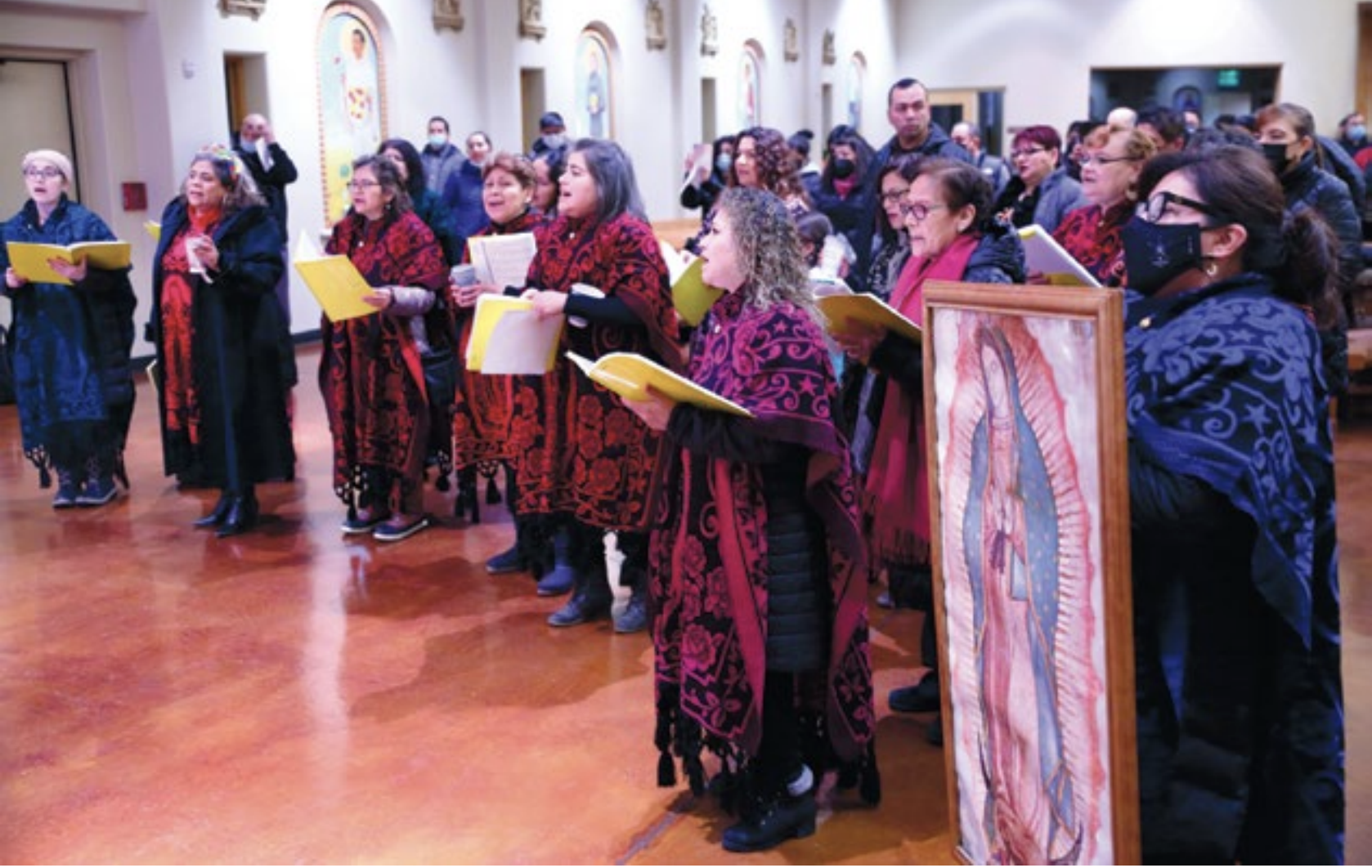
Choir and parishioners at the Las Manañitas service, paying homage to Our Lady of
Guadalupe.
Coro y feligreses en la celebración de Las Mañanitas cantan en homenaje a Nuestra
Señora de Guadalupe. December 12, 2021, Our Lady of Guadalupe Church in Anchorage. Diciembre 12, 2021, Iglesia de Nuestra Señora de Guadalupe en Anchorage.
A MESSAGE OF EMPOWERMENT BEYOND MEXICO
OUR LADY OF GUADALUPE’S story does not end there. When she appeared to Juan Diego, the Virgin Mary had brown skin and spoke his language. For the first time, a people unheard, unseen, and disenfranchised felt that someone was paying attention to them and faithfully visited Our Lady of Guadalupe’s Basilica. Her empowering message made her a religious icon in Mexico, and the Church declared her the country’s patron saint.
To this day, millions of Mexicans venerate her and celebrate the miracle on December 12. Nearly 11 million believers joined the last pre-pandemic pilgrimage to her Basilica for the 2019 festivities.
Devotion to Our Lady of Guadalupe knows no borders, and Mexicans living in the US join the celebration from their adopted homeland.
Each year, hundreds of devotees gather in the Los Angeles Cathedral to sing for her the Mexican birthday song. Hundreds of runners relay a torch from the Guadalupe Basilica to Saint Patrick’s Cathedral in New York for the Antorcha Guadalupana Race since 1997. Mexicans in Denver stage a play that intermingles the stories of the miracle and the daily lives of immigrants in a fictional town. And more than 200,000 devotees attend Chicago’s Our Lady of Guadalupe Sanctuary every year. Some make pilgrimages from nearby churches or neighboring states, making this the second-largest celebration of Guadalupe in the world.LA HISTORIA DE NUESTRA SEÑORA DE GUADALUPE
UN JOVEN indígena nacido en México vivió un milagro el 12 de diciembre de 1531. Él era pobre y sentía que las autoridades a menudo hacían de lado a la gente morena como él. Pero aprendió que las personas olvidadas por la sociedad también pueden tener cierta influencia, e inspiró a generaciones de mexicanos a seguir su ejemplo.
Su nombre era Juan Diego Cuauhtlatoatzin, pero la historia lo recuerda simplemente como Juan Diego. Vivía cerca del Cerro del Tepeyac en lo que ahora es el norte de la Ciudad de México. Un poema conocido como Nican Mopohua narra el milagro en la lengua que hablaban los aztecas, el náhuatl.
El poema cuenta cómo Juan Diego caminaba por el Tepeyac escuchando el canto de los pájaros cuando se percató de que el cerro también cantaba. La música era muy hermosa y parecía flotar en el aire. Así que Juan Diego pensó que aquello era solo un sueño. Pero luego prestó atención y escuchó que el cerro decía su nombre: “Juanito, Juan Dieguito”.
Juan Diego subió al Tepeyac para descubrir que no era el cerro quien lo llamaba sino una majestuosa dama “de admirable perfección.” Su vestido era brillante como el sol; las rocas donde se encontraba parecían hechas de jade, y los cactus que la rodeaban eran tan bellos como plumas de quetzal.
Juan Diego se inclinó y escuchó: “Hijo mío, el más pequeño, Juanito, ¿a dónde vas?” preguntó la señora. El joven le explicó que iba al catecismo.
Entonces, la mujer se presentó. Soy “la madrecita del dador de la vida, del inventor de la gente”, del dueño de lo que está cerca y lo que está lejos, de los cielos y de la superficie terrestre. Ella le dijo a Juan Diego que quería un templo donde pudiera derramar sus bendiciones sobre quienes se encomendaran a ella. Y lo instó a visitar al obispo y pedir que se construyera.
Ese mismo día, Juan Diego se presentó ante el obispo Juan de Zumárraga, quien estaba a cargo de la diócesis de México, y le contó su historia. Pero Zumárraga no le creyó. El obispo pensó que la mujer que Juan Diego describía se parecía a Nuestra Señora de Guadalupe, pero ¿por qué la Virgen María se aparecería a un pobre indígena y no a un funcionario de alto rango?
¿Por qué la Virgen María se aparecería a un pobre indígena y no a un funcionario de alto rango?
Juan Diego partió desilusionado, pero en el camino de regreso volvió a ver a la Virgen. Juan Diego pensaba que él era demasiado humilde para llevar su mensaje. Así que trató de persuadirla de que se le apareciera más bien a un noble que tuviera voz en los más altos niveles de la Iglesia. Nadie, dijo, escucharía a un campesino sentado en “la cola o el ala” de la sociedad. Pero Nuestra Señora de Guadalupe respondió: “No son gente de rango mis servidores”, y por eso eligió a Juan Diego para llevar a cabo la tarea.
Juan Diego visitó a Zumárraga al día siguiente para reiterar el mensaje de la Virgen. Incrédulo, el obispo pidió pruebas de su naturaleza divina. Cuando el joven salió de la oficina de Zumárraga, el obispo ordenó a sus hombres que lo siguieran. Lo intentaron, pero el muchacho se les perdió en el Tepeyac.
El joven debía regresar al día siguiente a la oficina del obispo, donde Zumárraga planeaba que se le arrestara. Pero ese no sería el destino de Juan Diego: su anciano tío Juan Bernardino enfermó, y esa noche tuvo que partir para la ciudad en busca de un cura que le diera a Bernardino su última confesión.
Al cruzar el Tepeyac, Juan Diego cambió de ruta. Su tío estaba gravemente enfermo y, en su prisa, el muchacho quería evitar a “la noble señora”. Pero sus esfuerzos fueron en vano; la Virgen se le apareció en el camino. Al verla, Juan Diego sintió miedo y vergüenza, y le prometió retomar su tar- ea una vez que se hubiera hecho cargo de la salud de su tío. La Virgen le aseguró que ella estaba allí para ayudarlo como lo haría una madre y luego hizo un milagro: sanó a Juan Bernardino.
La Virgen le dijo a Juan Diego que subiera al Tepeyac y recogiera las flores que crecían donde ella se le apareció por primera vez. Apenas crecían flores en aquel árido cerro, pero Juan Diego encontró en la cima un jardín en flor. El joven recogió las flores en su túnica, según lo había indicado la Virgen, y las llevó a la oficina del obispo como la prueba que él había pedido.
Cuando Zumárraga lo recibió, el joven extendió su tilma y el obispo fue testigo de otro milagro de la Virgen de Guadalupe: su imagen se pintó en la tilma mientras las flores caían al suelo. Zumárraga clamó a la Virgen María que perdonara su incredulidad y ordenó la construcción de la Basílica de Nuestra Señora de Guadalupe en el cerro del Tepeyac.
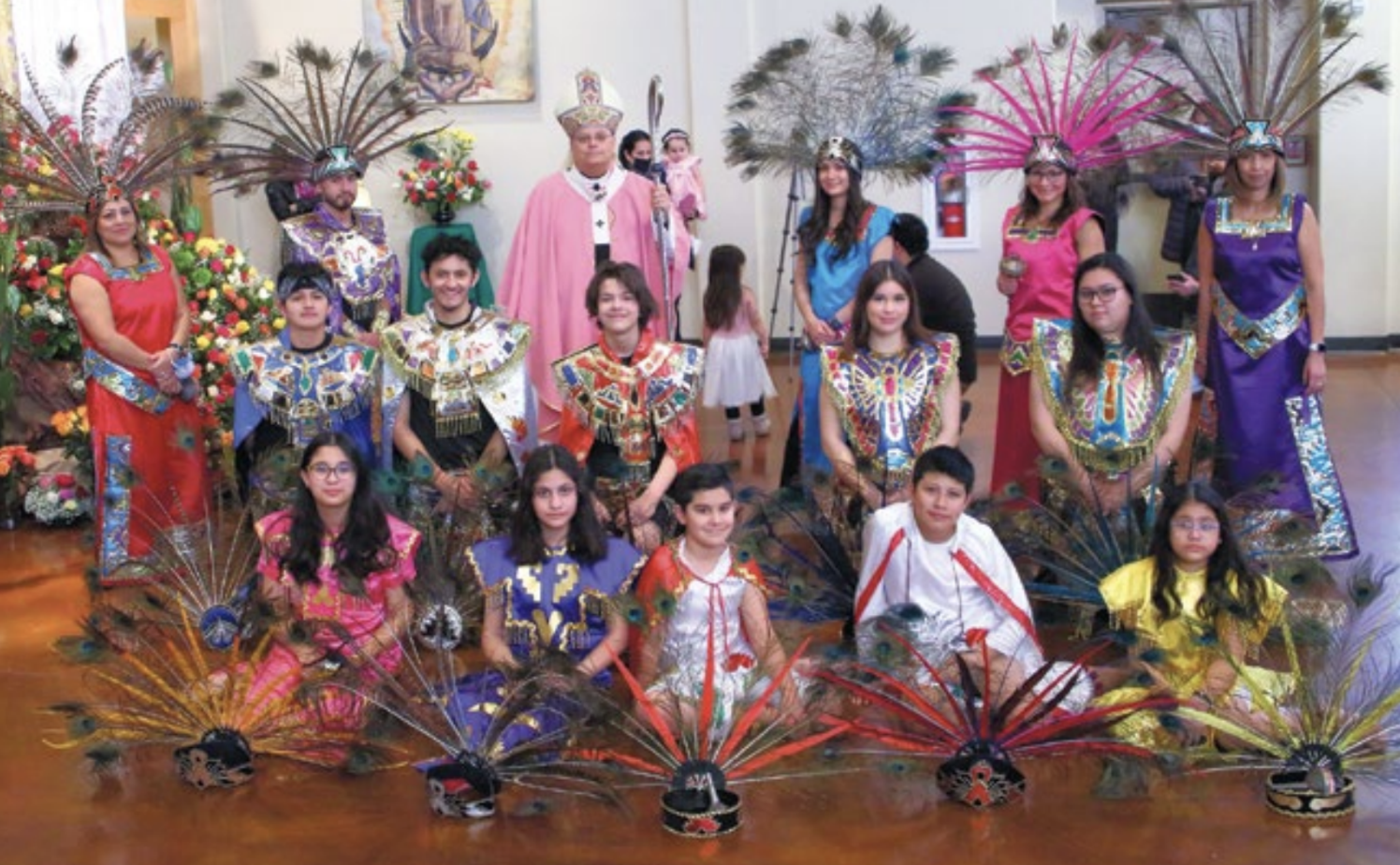
Danza azteca durante la misa de 11:30, con el arzobispo Belisario.
Aztec dance during the 11:30 Mass with Archbishop Bellisario joining. Diciembre 12, 2021, Iglesia de Nuestra Señora de Guadalupe en Anchorage. December 12, 2021, Our Lady of Guadalupe Church in Anchorage.
UN MENSAJE DE EMPORDERAMIENTO MÁS ALLÁ DE MÉXICO
PERO LA HISTORIA de Nuestra Señora de Guadalupe no termina ahí. Cuando se le apareció a Juan Diego, la Virgen María tenía la piel morena y hablaba su idioma. Por primera vez, las personas que no tenían voz, los invisibles y los olvidados por la sociedad sintieron que alguien les prestaba atención y empezaron a visitar fielmente la Basílica de Nuestra Señora de Guadalupe. Su poderoso mensaje la convirtió en un ícono religioso en México y la Iglesia la declaró santa patrona del país.
Millones de mexicanos la veneran en la actualidad y celebran el milagro cada 12 de diciembre. En 2019, casi 11 millones de creyentes se unieron a la última peregrinación a la Basílica antes de la pandemia.
La devoción a Nuestra Señora de Guadalupe no conoce fronteras, y los mexicanos que viven en los Estados Unidos también la celebran desde su patria adoptiva.
Cada año, cientos de feligreses se reúnen en la catedral de Los Ángeles para cantarle Las Mañanitas. Un buen número de corredores hacen relevos con una antorcha desde la Basílica de Guadalupe hasta la catedral de San Patricio en Nueva York durante la carrera de la Antorcha Guadalupana, que se celebra desde 1997. Los mexicanos radicados en Denver presentan una obra
de teatro que entremezcla la historia del milagro y la vida cotidiana de los inmigrantes en un pueblo ficticio. Y más de 200,000 devotos asisten al Santuario de Nuestra Señora de Guadalupe en Chicago cada año. Algunos peregrinan desde iglesias cercanas o incluso desde los estados vecinos, lo que la convierte en la segunda celebración de Guadalupe más grande del mundo.
La Virgen también vela por los mexicanos que viven en Alaska. La celebración de Nuestra Señora de Guadalupe en Anchorage se remonta a la década de 1970. Los feligreses se reúnen a las 5:00 a. m. para dar una serenata a Nuestra Señora de Guadalupe en su iglesia. También la celebran durante la misa dominical. Quienes asisten a la celebración comparten un lenguaje que los conecta más allá de las palabras: el de la empatía, la bondad y la compasión.
Durante la fiesta de Nuestra Señora de Guadalupe, feligreses de todas las clases sociales unen sus voces para recordar que ella se le apareció a Juan Diego como una mujer morena, que hablaba una lengua indígena. Y cantan, bailan y oran para celebrar el milagro que ha empoderado a millones de mexicanos. ■
FORUM is a publication of the Alaska Humanities Forum. FORUM aims to increase public understanding of and participation in the humanities. The views expressed by contributors are not necessarily those of the editorial staff or the Alaska Humanities Forum.
The Alaska Humanities Forum is a non-profit, non-partisan organization that designs and facilitates experiences to bridge distance and difference – programming that shares and preserves the stories of people and places across our vast state, and explores what it means to be Alaskan.

October 19, 2026 • Adam Mackie
September 21, 2026 • Taylor Strelevitz
August 27, 2026 • Eiden Pospisil