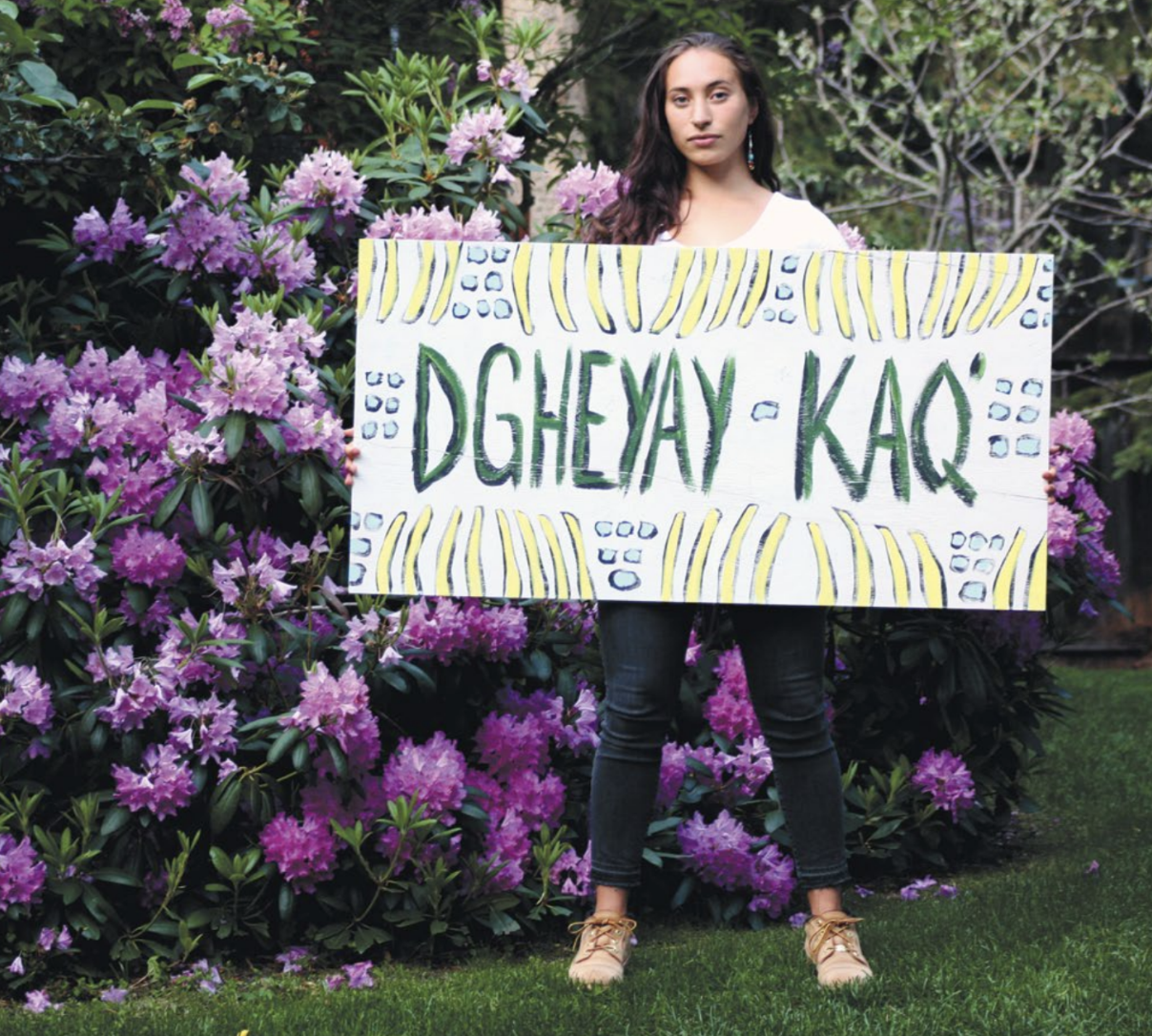
Ruth Łchav’aya K’isen Miller PHOTO BY MELISSA SHAGINOFF
Ruth Łchav’aya K’isen Miller PHOTO BY MELISSA SHAGINOFF
By Melissa Shaginoff
Summer 2020, FORUM Magazine
ATHNA ELDER WILSON JUSTIN once told me a Land Acknowledgment is when you present a “happy face” and cross onto another’s land in a respectful way. Your “happy face” is putting on your beads and dentalium and introducing yourself in your language. You do this to offer respect to the stewards of that land, the Indigenous people, and to tell those stewards who you are and what you stand for.
Land Acknowledgment is a public statement recognizing the Indigenous people of a place. In Alaska we are on Indigenous land. Because of this truth, Land Acknowledgment has become a widely implemented practice across the state. It has largely become a performative signal of allyship and, from the outside, it leads us to believe we are doing the right thing. But what does Land Acknowledgment actually do for our communities within Alaska? What does it personally mean to hear, see, and say a Land Acknowledgment? Can Land Acknowledgment become action?
When I first heard a Land Acknowledgment I was attending a conference outside of the United States. I found myself within an institutionalized space where most of my peers were non-Native. This setting was not new to me. I listened as the chatter and networking around me quieted and the host approached the microphone. They welcomed all the attendees and thanked them for being there. With a pause they stated, “We are on Indigenous land.” They then proceeded to thank those specific people for their past and present stewardship of that place and to remind us that all places have both an Indigenous memory and an Indigenous contemporary story. In hearing this I felt my eyes tear and my throat tie into knots. I tried to calm myself as the host started again. Looking into the faces of my peers I realized my reaction, like my Native-ness, was singular in that room. This moment took time to process. I found myself asking the questions, “Why was I so moved by these words?”, and “Did other Indigenous people have a similar experience in hearing them?”
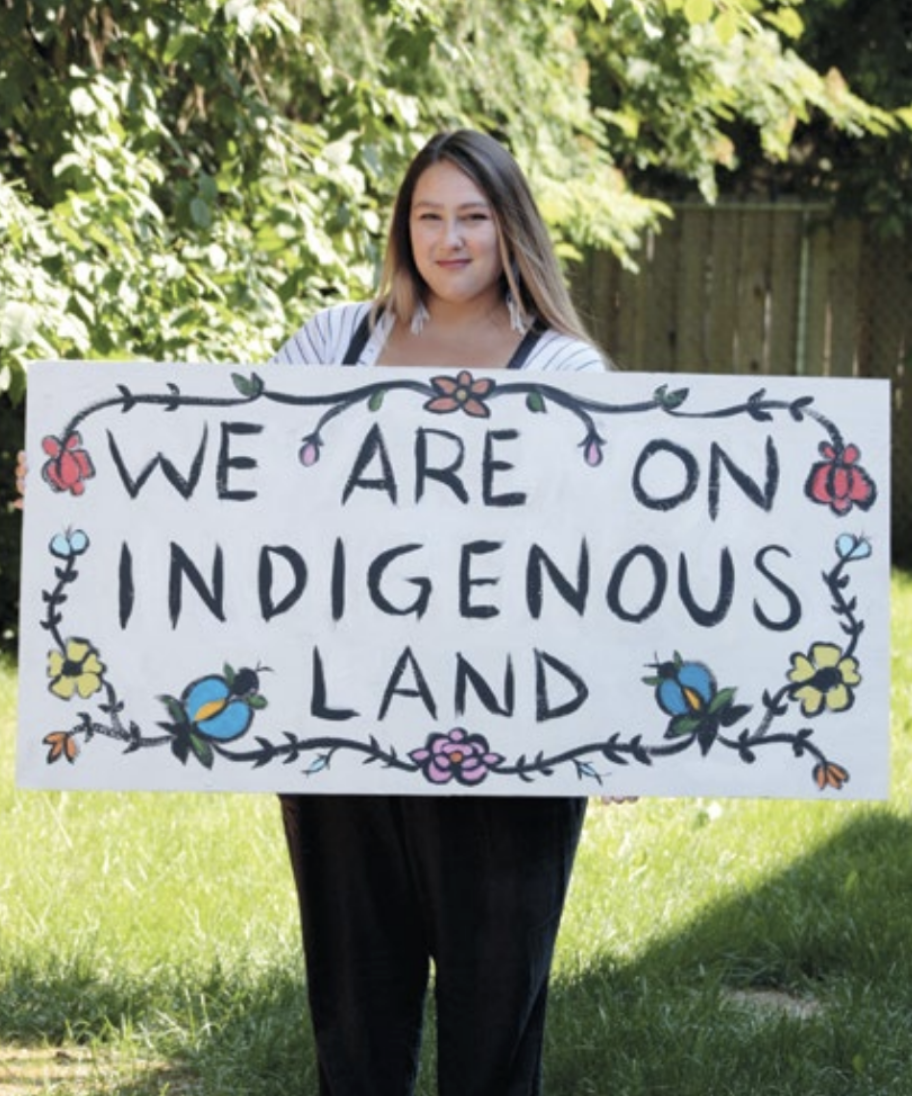
Melissa Shaginoff painted signs regarding Land Acknowledgment for friends and family to display outside their homes. PHOTO BY MELISSA SHAGINOFF
When I returned home I started researching the Land Acknowledgment movement and how it was communicated throughout the world. I found much Indigenous-authored content and criticism surrounding the movement, but none that seemed specific to Alaska or widely practiced by its institutions. I felt in many ways that Land Acknowledgment was already deeply rooted in Alaska Native ways of being, in our respect and public recognition of each other. Our relationship to the land and animals is sustainable and our ability to remember that we all stand upon the shoulders and work of our ancestors is a cultural imperative. But how can this knowledge be conveyed in words, in a few phrases, in a Land Acknowledgment? At this time in my work, I wanted to build something that created conversation about why we should or should not embrace Land Acknowledgment, while considering the deeper Indigenous beliefs of public recognition and gratefulness. This created the Land Acknowledgment Workshop.
In the Land Acknowledgment Workshop we start with the truth. We are on Indigenous land. Through guided conversation we talk about what Land Acknowledgment is, what it is not, and what it can be. In many instances, Land Acknowledgment opens a space with gratefulness, allowing Indigenous individuals to feel seen within what are traditionally settler situations. But it can also reinforce the erasure of Alaska Native people in both their history and current experiences. Land Acknowledgment is a performative statement. When it is not supported with sincerity or personal investment, Land Acknowledgment can be used with colonizing intent—removing obligation and accountability from individual allyship, leaving the hollow shell of institutional rhetoric. To avoid this, allies must ask: “What can Land Acknowledgment be, and what does it actually do?”
Land Acknowledgment has largely become a performative signal of allyship and, from the outside, it leads us to believe we are doing the right thing. But what does Land Acknowledgment actually do for our communities within Alaska?
Land Acknowledgment can be a chance to look inward. To evaluate personal power and privilege within colonial systems and strategize how to give both away. This way of thinking embodies Indigenous ideologies that value allegiance and the reciprocal work of knowing someone. As an Ahtna person, I grew up in a visiting culture that taught me how respect comes from telling someone who you are, where you come from, and what you stand for. When you enter a person’s territory you put on your “happy face” and you introduce yourself in your language. This offering is a moment in which you give a little bit of yourself with the hope that the other person will do the same. In Dene leadership, power lies in the ability to understand one another.
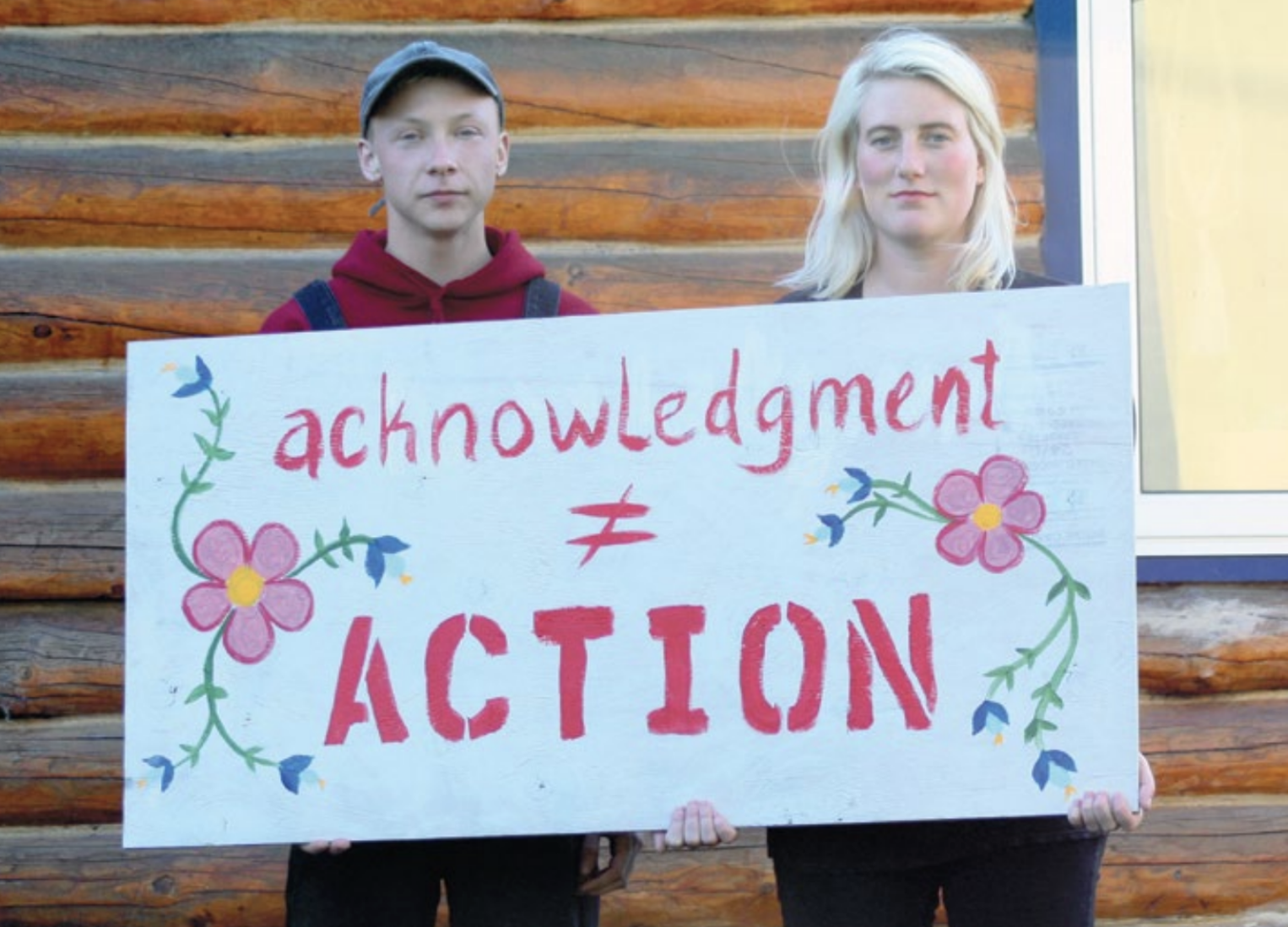
Quinn Christopherson and Emma Sheffer PHOTO BY MELISSA SHAGINOFF
Land Acknowledgment is also a moment to reflect on ways to invest in actions of reconciliation. As citizens, visitors, and intruders it is our responsibility to know the sovereign tribal entities and Indigenous organizations within each place we move. We should do the work to understand their structures, their values, and their current work. It is our responsibility to invest in those entities’ success through equitable means. This is how we can turn the words of Land Acknowledgment into action. Learning about the sovereign tribal entities and Indigenous organizations informs our Land Acknowledgments, and holds us accountable in supporting these important groups.
Acknowledgment becomes action when we do the personal work of evaluating our contributions to colonial institutions and considering how that work does or does not include Indigenous people, knowledge, or ways of being. It is important to ask: “What actions meaningfully contribute to equity and how can we substantiate this learning?” This personal work recognizes truth. In the case of Land Acknowledgment, truth counters the settler narratives of the “untouched wild” or the “last frontier” that remove Alaska Native people from history. The land, in what is now called Alaska, is an incredibly old and cared for place, and Alaska Native people are the only people to have sustainably lived here for thousands of years. Honoring that legacy by looking to Alaska Native Elders and youth for guidance is the only way forward. We must take action to be respectful guests, as we continue to be here alongside Alaska Native people.
In this time of pandemic, when we cannot gather, what does Land Acknowledgment become? How can we create visibility of Indigenous work without a platform to speak? Over the next few months, I will be working with various community groups to explore Land Acknowledgment in physical work. Through personal signage, public murals, and community conversation I will collaborate in developing new ways that Land Acknowledgment can take form as we navigate the current and multi-faceted situation of pandemic, protest, and subsequent isolation and division. There is an opportunity to innovatively reconstruct the formula of Land Acknowledgment into one that values in-depth personal work, honoring Indigenous ways of being, and actions of accountability.
We are on Indigenous land.
Melissa Shaginoff is part of the Udzisyu (caribou) and Cui Ui Ticutta (fish-eater) clans from Nay’dini’aa Na Kayax (Chickaloon Village). She is an artist and curator. Her Land Acknowledgment workshops are offered through her website at melissashaginoff.com
FORUM is a publication of the Alaska Humanities Forum. FORUM aims to increase public understanding of and participation in the humanities. The views expressed by contributors are not necessarily those of the editorial staff or the Alaska Humanities Forum.
The Alaska Humanities Forum is a non-profit, non-partisan organization that designs and facilitates experiences to bridge distance and difference – programming that shares and preserves the stories of people and places across our vast state, and explores what it means to be Alaskan.
October 19, 2026 • Adam Mackie
September 21, 2026 • Taylor Strelevitz
August 27, 2026 • Eiden Pospisil