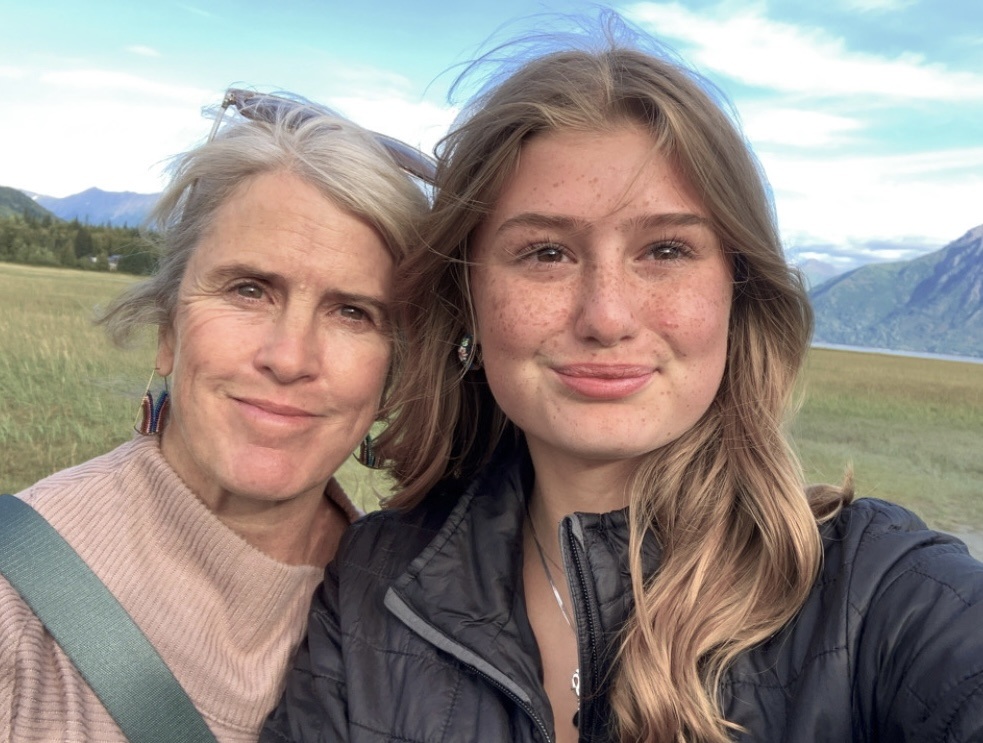
Cooper CarrAnaya and her mom, Polly Carr
Eiden Pospisil • August 27, 2026
Last spring, West High freshman Cooper CarrAnaya experienced Story Works for the first time. The daughter of AKHF’s VP of Programs & Partnerships Polly Carr, Cooper was excited to experience a program she had heard her mom talk about - a LOT.
In April, Story Works arrived in Cooper's freshman English classroom the way it does at schools across the Anchorage School District: with a spot on the teacher's quarterly calendar and a little bit of mystery about what, exactly, two weeks of "storytelling" would actually involve. When her teacher, Ms. Roedl, announced the program to the whole class, Cooper was already sold. "I'm really close with Ms. Roedl, we chat it up all the time," she says.
Story Works is a two-week storytelling program that empowers students to share stories from their own experiences, with the aim of building empathy and healthy classroom environments. Facilitators embed in an English class for those two weeks, supporting students as they develop their stories, with the opportunity for everyone to share their story with the class at the end.
What she wasn't quite prepared for was how strange it would feel, at first, having other adults take over her English class for two weeks. "I do love Ms. Roedl, she was my favorite teacher," Cooper says, "but I thought it was really cool to kind of get a different experience with a different teacher in the same subject." What stuck with her most was watching her own teacher sit with the class as a participant. "It felt like she was also learning about the material as we were going."
Even the shape of the two weeks felt different. Ms. Roedl's classroom already ran on a variety of different assignments most days. Story Works asks the class to stay with one focus the whole time. The harder part was figuring out what to actually say. Cooper cycled through a few memories before settling on a story about getting locked out of her house one December evening - one her mom, she jokes, wanted told very carefully: "She wanted me to make it clear that it was an accident, and I was like, okay!” She landed on that story because it was the one she could actually talk about at length. "Some other subjects, I didn't have much to say on. So, yeah, that's why I kind of landed right there."
Cooper CarrAnaya and her mom, Polly Carr
Once she had it, she wasn't the type to keep reworking it. "I hate writing a rough draft of a thing," she says. "I like to have whatever my material down right away, and it's not the best trait to have, but that's just kind of how I am." She didn't memorize it, either, she just planned to talk.
By the time she volunteered to go first (also, she says, just how she operates), any nerves from the first days of the workshop had burned off. "I was just mostly excited to share. I just don't get that nervous in that specific class, because I'm comfortable with all the people in it."
It's what happened once everyone else started sharing that Cooper keeps coming back to. "It just kind of unlocked so much more about other people," she says. "Even though it's one story from their life, I think it opened up my perspective on everyone. I felt like I knew them so much better than before, just because you can tell who they really are when they're sharing something so vulnerable about themselves." She and Ms. Roedl ended up crying in the back of the room during some of the shares.
The effect didn't stay in the classroom. "The next day after Story Works, I felt like there was kind of a shift in the room," Cooper says. She overheard classmates seeking each other out, "hey, super cool story, I loved it" and pointing out specific details from each other's stories. "I felt like it made everyone pay attention to, you know, kind of learn who was actually standing in front of them and who they were. I felt like that whole program just made us all come even closer than before."
Months out from the workshop now, Cooper doesn't talk about it like an assignment she completed. She talks about it like something that changed how she moves through a classroom. "It just builds so much perspective for everyone," she says. "It made me think a lot about myself and then other people. In classrooms, on projects, you're not really thinking about everyone else in the classroom, you're mainly thinking about yourself. To have that experience where you are thinking about literally everyone inside of the classroom is just a really wonderful thing."
Her advice for a student about to go through it: pick something you actually care about, and don't worry too much about the audience. "They're not going to do anything but listen," Cooper says. "They're gonna be thinking about how your story has impacted you, and how it's made you who you are, that's what matters. So yes, you're gonna have some nerves, but all in all, it's such a cool experience."
And for a teacher or community member wondering whether it's worth bringing in: "It helped me and my classmates become so much closer," Cooper says, "and it helped me as a student understand some people more, and have a broader perspective of everyone. It also built my speaking skills, and really had me think on things. It was just a great experience; it needed to happen."
Story Works is a program of the Alaska Humanities Forum that brings community volunteers into Alaska high school English classrooms to support student storytellers. It is supported in part by a grant from the Municipality of Anchorage. Learn more at akhf.org/programs/story-works.
The Alaska Humanities Forum is a non-profit, non-partisan organization that designs and facilitates experiences to bridge distance and difference – programming that shares and preserves the stories of people and places across our vast state, and explores what it means to be Alaskan.

October 19, 2026 • Adam Mackie
September 21, 2026 • Taylor Strelevitz
August 27, 2026 • Eiden Pospisil