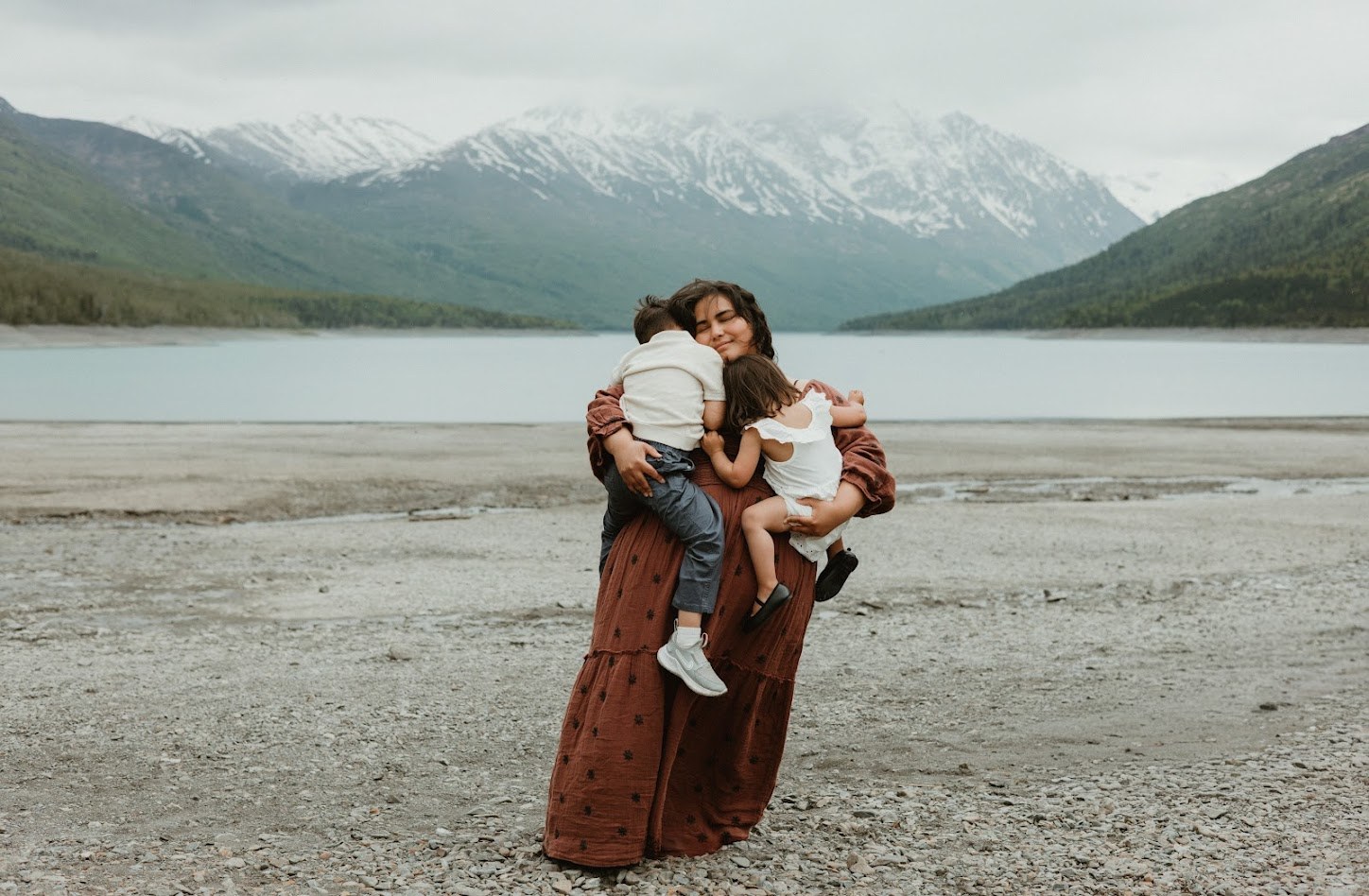
The feeling of motherhood. Photo credit: Nicole Ann Photography.
The feeling of motherhood. Photo credit: Nicole Ann Photography.
By Elizabeth Pantaleone
Spring 2026, FORUM Magazine
“No, my mama,” my little wildflower has been saying this phrase for a few weeks now. Alternating between “mama,” “dada,” and “ninny.” The fun of rebutting with “no, my husband” as she giggles at the thought of anyone having a relationship with her mom and dad, as she does. My children have always giggled while being silly and are rarely out of sight. I think about the contrast between my upbringing and theirs, how my daughter is speaking miles ahead of me. How my son is not afraid to have big emotions out of fear of being called a “baby.” To give them that security feels like one of my best and proudest accomplishments.
I became a mom on a cold January morning in 2022; the hospital still had COVID protocols in place, which meant the entire process would just be my husband and me. We arrived at 5 am through the ER entrance with masks up. It was quiet but warm as we were led down the hall by security to labor and delivery. During admission, we both were tested, a Q-tip up the nose like we’ve done a handful of times before. The nurse counted, “One, two, three, four…” My eyes closed, not because it hurt but because I was scared it would be positive and was unsure what that would mean when it came to meeting my son.
“You’re both negative, the only two so far,” the nurse mentioned the increase in positive tests due to holiday gatherings and people traveling. The rest of the process felt like a blur: the multiple pokes in my hand for the IV, the anesthesiologists making sure I understood the process, the feeling of my body numbing from the neck down for a planned c-section that would ensure my son, who was 8lbs 14 oz, would come into the world safely.
Becoming a mother, at the tail end of a pandemic, was an adventure, but felt like the easiest part of the entire journey. I stayed home with my son for the first five months of his life while finishing my Master's degree in clinical psychology. Once all was said and done, and I walked across that stage, I knew I needed to do something. I was bored, having already binged all of Teen Mom and every installment of Scream during nursing sessions and frequent contact naps. I was ready to go back to work, to utilize a degree I worked so hard to get.
<hold for image>
My entire education and work experience were done so I could make a difference. I wanted to be a support for children like me, who have had tough times and felt alone because of it. I wanted to show them that they weren’t alone, that despite everything, they were still worthy. I wanted to be a clinician, to counsel children and be a safe person, except that when I was ready, we didn’t have any childcare lined up.
It wasn’t because we didn’t think about childcare; in fact, it was something we’d talked about many times throughout the pregnancy. My husband ran down the stairs after a team meeting, “My co-worker said we should get on the waitlist now, because they are like 6 months out,” with panic setting in. Instead of doing that, we had a long conversation that ended with my mother-in-law excitedly agreeing to watch our son.
As the due date approached, we wanted to get the logistics down, that’s when we got wind that my mother-in-law would not be able to retire as she planned because of insurance and benefit reasons. She was adamant that she could still watch him, and I knew she wanted to, but realistically, her ever-changing work schedule would not allow it.
I eventually got a position at the same company I had interned with during my graduate program and was granted the ability to work part-time for the first few months. In the summer, we relied heavily on the village we created, neighbors, family friends, grandmothers, and great grandmothers, lending a hand when they could to get us by. Occasionally, I would have to take unpaid time off, as there was no one to watch him that day.
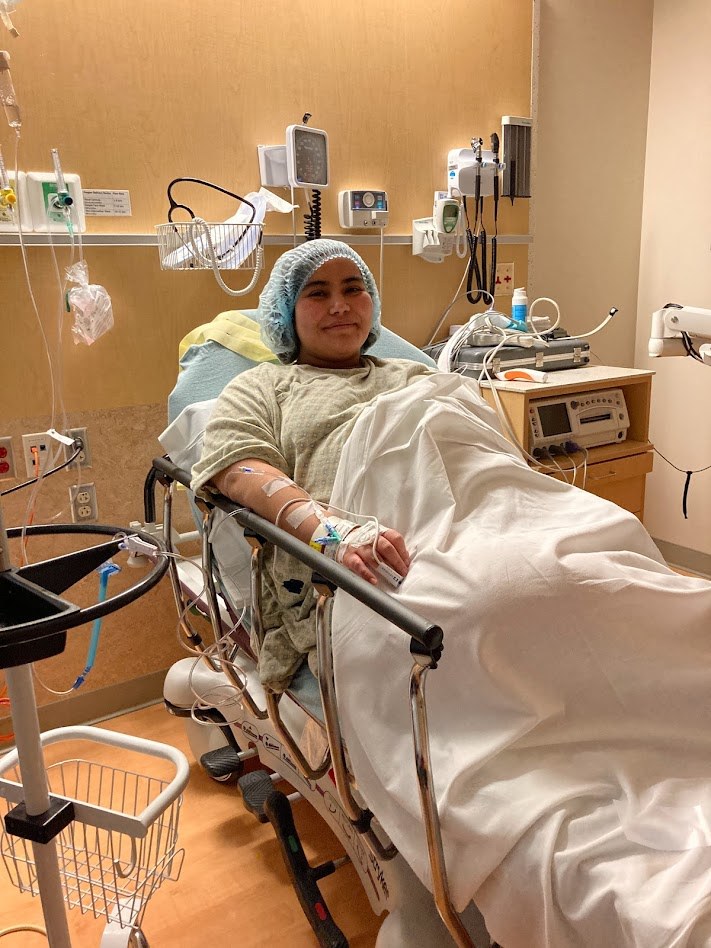
Elizabeth is awaiting a cesarean surgery on a cold January morning. Photo Credit: Robert Pantaleone.
The impact of it felt heavy, and by the first snowfall, I truly believed I’d have to quit the job I just started and become a stay-at-home mom again. Then we met Christine, a young certified nursing assistant (CNA) who happened to transition from nanny to an in-home daycare. I messaged her on Facebook requesting to visit her location. She had a spot open short-term and was willing to watch our son for a few weeks. She was great with the kids, and communication was consistent, and as our time there was coming to an end, panic set in again. The search for reliable, affordable childcare was looming, until she messaged, “I can watch your son a little longer, if you’re okay with him being with four older toddlers.”
It was truly a blessing; our child care provider was trusting, and the relationships built there were so great that we decided to bring my daughter into the world. We were in bliss for three years, until we got the bad news. Our provider would be closing her doors in August; not only that, but I was in the process of switching jobs in a different field, leaving us back where we started. I was in problem-solving mode, but was hit with similar responses from multiple centers. “We have a space for your son, but there’s a waitlist for our infant rooms.” At the time, my daughter was 15 months old and not yet a “toddler,” to licensing standards.
Not only was there no space, but the cost of childcare had increased so much that when we finally found a spot for both, we would be paying a bill that was more than our mortgage. This is the reality for many Anchorage families, but the issue is more severe for those in rural Alaska. To change the system of childcare and early childhood education has been a battle, one that everyone agrees is necessary, but solutions feel scarce. We factor this in as we discuss the idea of a third. Would we be able to afford it? What would we have to give up for it to fit our budget?
They are what I am most proud of, and I know firsthand that this life shouldn’t be taken for granted.
Questions I know others ask themselves as they contemplate growing their family, buying a house, or thinking of when they can retire. Navigating a world different from those before us, new and unforgiving at times, but despite it something keeps us going. Hope maybe? Or maybe it’s the idea that our children will be adults one day.
One day, they will grow up, follow their dreams, and create their own community. What will it have? What will our children take from us with them into their own lives?
When I look at my daughter, I see her eyes wide with curiosity, looking for ways to explore while holding my hand. When I look at my son, I see someone whose soul is as gentle as the fern leaves growing wild in our yard, gleaming in the midnight sun. They are what I am most proud of, and I know firsthand that this life shouldn’t be taken for granted.
That’s why we keep going, why we work towards change instead of bowing our heads. We advocate for what we think is right and what we want for our future, because our children are watching, just like we watch them. I could have been a stay-at-home mom, budgeting our money for an efficient household. But I don’t think that was for me, and maybe that’s because that wasn’t what I saw growing up. The women in my family tend to work opposite shifts from their spouses. They would be home with their children during the day, working all night, because at the time, that was the only way to survive. I work not because staying at home life is “easier,” or “harder,” but because I have the choice. A privilege that was not allotted to those before me, even if that was all they wanted. ■
Elizabeth Pantaleone (2026 FORUM Storytelling Fellow) is a life-long Alaskan, passionate about advocating for the increase of quality childcare and early childhood education in her community. She holds a Master of Science in Clinical Psychology and Graduate Certificate from the University of Alaska Anchorage. She holds a Bachelor of Arts in Psychology with minors in early childhood development and philosophy from Cal Poly Humboldt (formally Humboldt State University). Elizabeth is currently an Early HeadStart Coach, supporting teachers in strengthening instructional practices through Conscious Discipline training and CLASS observations. Elizabeth started a personal photography project Dember 2025 entitled "Through Their Eyes: Alaska" focusing on the untold stories of Anchorage's childcare crises through interviews accompanied by portraits. Through this writing fellowship, Elizabeth aims to highlight the successes and challenges of early childhood education in Alaska. Raising awareness about the essential role early childhood care and education plays in Alaska's economy, the struggles educators and families are facing and a look forward in search for hope.
FORUM is a publication of the Alaska Humanities Forum. FORUM aims to increase public understanding of and participation in the humanities. The views expressed by contributors are not necessarily those of the editorial staff or the Alaska Humanities Forum.
The Alaska Humanities Forum is a non-profit, non-partisan organization that designs and facilitates experiences to bridge distance and difference – programming that shares and preserves the stories of people and places across our vast state, and explores what it means to be Alaskan.

July 24, 2026 • Annie Garay
July 23, 2026 • Taylor Strelevitz & Polly Carr
July 17, 2026 • Polly Carr