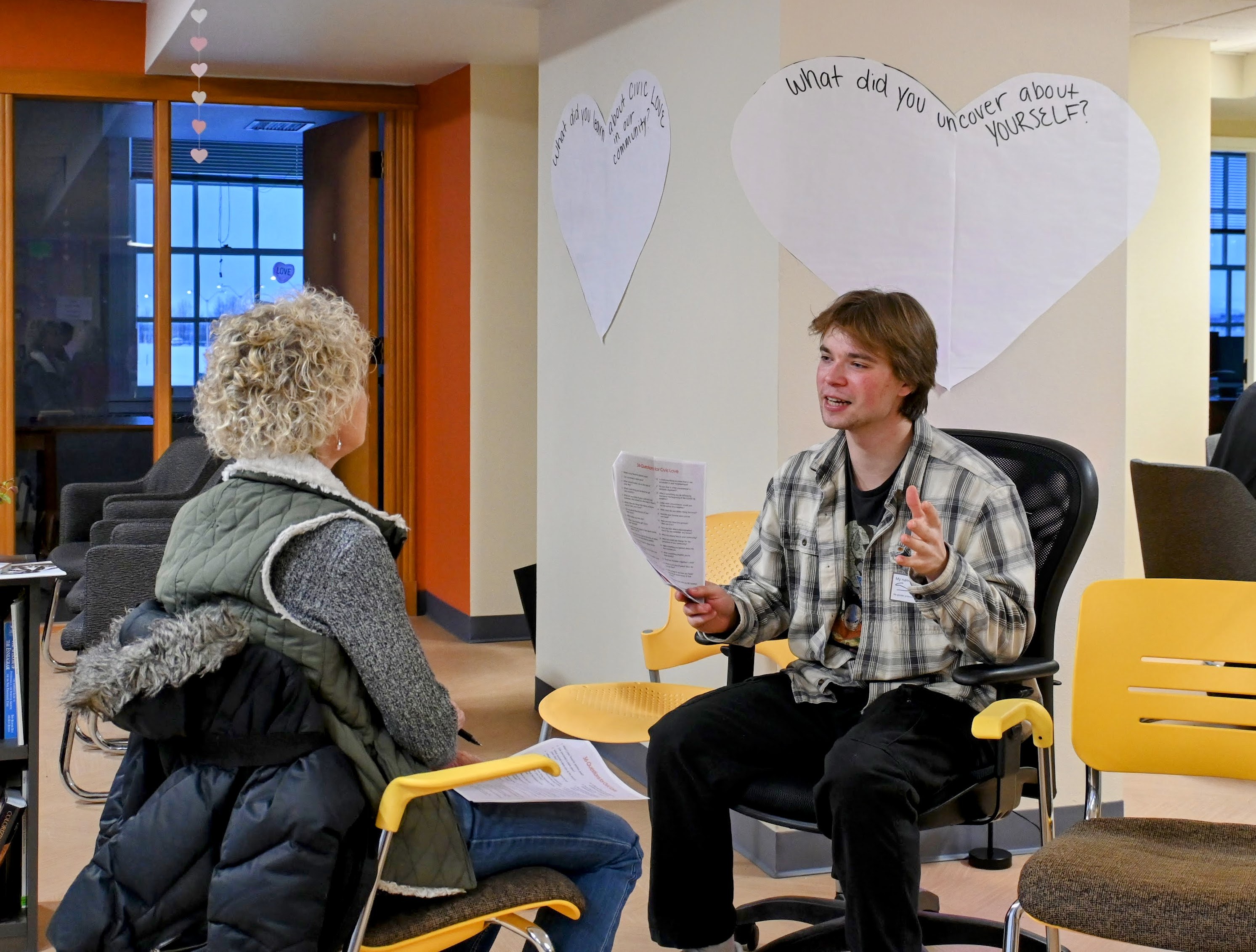
Soren Shafer and his conversation partner at 36 Questions for Civic Love
Taylor Strelevitz • March 5, 2026
I met Soren at 36 Questions for Civic Love. It was his first Alaska Humanities Forum event.
He didn’t know quite what to expect. His mom had handed him a flyer and said, “you should do this.” At the time, he was reading bell hooks’ All About Love.
“I was already inspired to talk about love,” he told me. “There is power to talk about it and put it out into the world.”
He researched the Alaska Humanities Forum and decided he wanted to learn more. So he drove through an impending snow storm to sit across from a stranger and practice it.
Soren is a second year Psych major at UAA. He wants to focus his work on caregivers of loved ones with dementia.
“Someone is losing themselves,” he told me. “Compare it to a child who is gaining themselves. The brain changes so much as a child and with dementia.”
For him, civic love is not abstract. It lives in living rooms and support groups. In the quiet, relentless reality of decline.
“It’s so hard to be a single parent. It’s the same thing if you’re caring for someone with dementia. We need each other.”
Soren Shafer and his conversation partner at 36 Questions for Civic Love
In one of his psych classes, Soren learned that Alaska ranks low on all of the Big Five personality traits, the five broad dimensions psychologists use to describe human personality. It made him curious about how our community understands itself.
Anchorage, he noted, is one of the least densely populated cities. Many have their own vehicles. There is a certain population density that is optimal for public transportation. If we want to have important conversations that are accessible, that matters.
He connected this to what we see around us: high rates of suicide, substance use disorder, and homelessness, largely due to a lack of community.
“We are radically disconnected,” he said later. “I want to see us radically connected.”
During the 36 Questions, he was paired with someone thirty years older than him. He says he thinks he was the youngest person in the room by about ten years.
“I didn’t let it be intimidating. I tried hard to not undervalue my own experiences or my own voice. I didn’t want to diminish the impact I could have on a person.”
What stood out most was the structure.
“The idea to not respond is thought-provoking. I was able to sink in without expectations, strategize, or build a picture of who this person is. Just listening without trying to impose yourself. Just listening, you get to slow down and actually hear this person talking. It was fun.”
He realized something about himself in the process.
“I grew up thinking I was an introvert but I love being around people. I love listening to people talk. I like sharing space where people get to express themselves openly. It is so easy. Everything we find difficult about talking to people is self-imposed.”
One question really stuck with him: When is it ok to call the police?
He and his partner broke the rules and responded to each other.
“My perspective initially was that if there is a secure community you can feel comfortable asking if someone is ok. If you don’t have community then we don’t ask that and there is a separation. Then we need to have an outside force intervene.”
As they talked, they reflected on a past experience when his partner felt she should have called the police.
When I asked what he took with him from the experience, he didn’t hesitate.
“How can this happen more often in a more intuitive way so it’s more widespread? This should be happening every week. We should get a cohort of people and cycle around and see what happens to this small little community.”
He noticed that many people arrived with chatter in their heads about politics and our polarized country. He thinks it was quieted and soothed by the structure.
“We have a lot of self-efficacy in deciding what deserves our attention. This is a very confusing time. What do we choose to give our energy to?”
He wants to do more of this. “I’d like to be louder, talk to more people, share my influence and share what I want to say. And do more to create events like this. Facilitating an event like this would be so fun. It would be fun to do with Alzheimer’s Resource Alaska.”
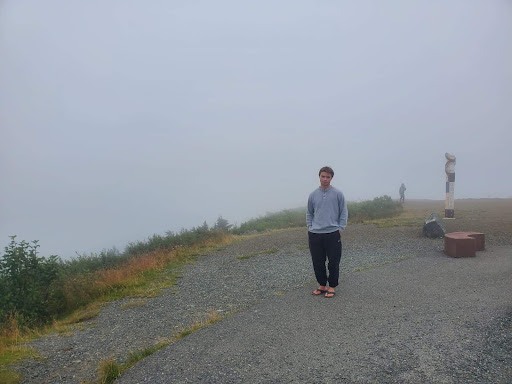
Soren Shafer
One question Soren is still carrying?
“What’s your favorite kitchen smell?”
Everyone has an answer. Smells are so close to our sense of memory. “Anything in the morning that I can wake up and smell. As I’ve gotten older, it’s coffee.”
His advice to someone trying this for the first time is simple.
“It’s easy to feel love. If you enter from love everything flows from there. With a loving perspective everything is easy.”
In a place he describes as radically disconnected, he was left wondering what might happen if we became radically connected.
The Alaska Humanities Forum is a non-profit, non-partisan organization that designs and facilitates experiences to bridge distance and difference – programming that shares and preserves the stories of people and places across our vast state, and explores what it means to be Alaskan.

September 21, 2026 • Taylor Strelevitz
August 27, 2026 • Eiden Pospisil
July 24, 2026 • Annie Garay