By Jean Anderson
Originally published in "Frame of Reference," the Forum newsletter, April 1998
Winter 2021-2022, FORUM Magazine
Death, graffiti and thoughts on making art in Alaska.
WINTER is a season of death. But to my introverted mind it’s always seemed fertile, a time rich with time—season of rebirth, for thoughts, ideas, conversations, visits, stories. Any sun-drenched wintry Saturday in November, like one just a few days ago, might be a setting. I should have been ready. On this specific morning, while I stood gazing out my bedroom window in suburban Fairbanks, trying to read the faint graffiti of fresh tracks in the snow as l talked on and on, long-distance, tangled up in a long-winded and troubling conversation with a stranger—well, a wintery and mysterious visitor did appear.
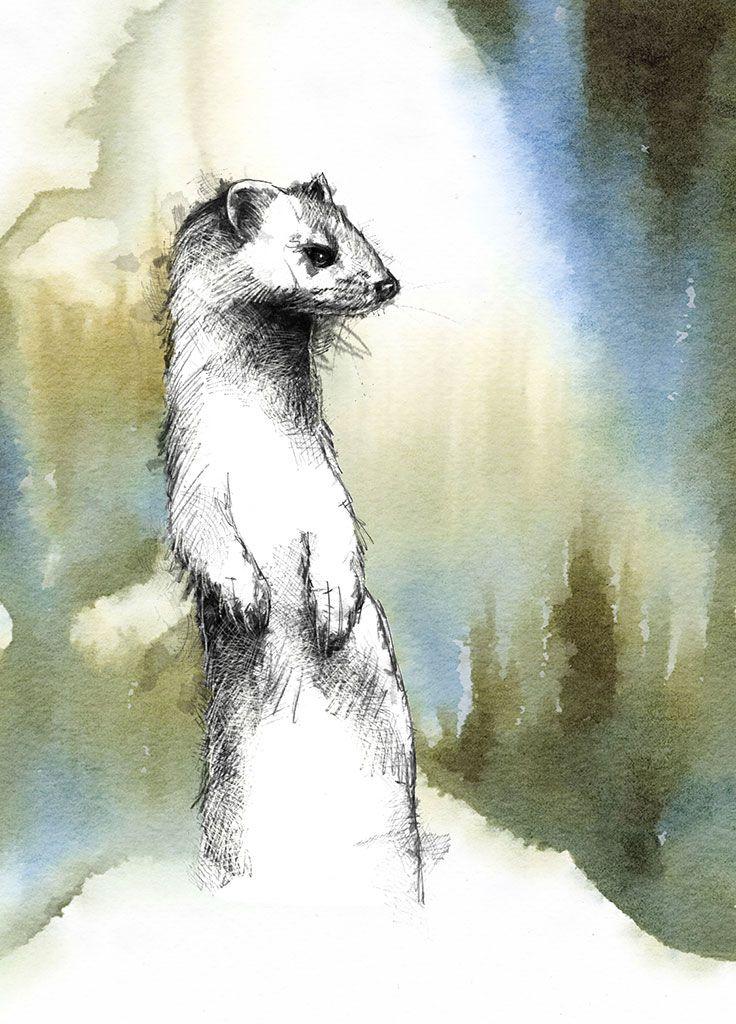
The phone caller was conducting a survey from Ohio. His questions were deft but complicated, precise, thought-provoking, troubling. He said he’d been hired (by whom? he couldn’t say) to select phone numbers in Alaska at random to ask the opinions of residents regarding development in the state. Big Oil, ANWR, greed, politics, international corporate power, and—yes—people, jobs, nature, responsibility, caution; these were my words, not his. While the caller asked question after carefully-phrased question focusing on the state’s economy and on whether that economy is headed in a direction I support, the visitor—an ermine, beautiful, darting, wild—invaded our words. “Oh look!” said l in mid-sentence.
The creature was about seven inches long. In winter pelage,
to quote my tattered and beloved Merriam-Webster’s, c. 1972. Its coat was luminous, and the creature was beautiful, delicate-looking—oddly graceful, since its body seemed formed from a quirky mating between a mouse and an eel. Its movements were not simply quick or agile, though they were both, but as fast-moving as any ground animal I’ve ever observed, incredibly swift.
The creature was a rarity too, only the second ermine, or weasel, I’ve seen in thirty years in Alaska. But like that other, which was brown and summery, it was fearless, curious, shy, self-confident, and insistent.
lts coat was sleek; colored—or uncolored—a fresh and clean snow white except for a black tip of tail. Winter pelage. A small black nose; and the eyes, of course, which were black too, and startling. Remarkable glistening eyes, full of a curiosity beyond friendliness; intelligent-looking, quizzical, wholly communicative.
“Tell him,” those eyes seemed to be saying.
-2-
I STOPPED TRYING to articulate for the questioner in Ohio my fears about human greed swelled by huge corporations to an international disease, vast, ruining the world, seizing everything, while the ermine darted up and down the fieldstone steps my husband built several summers ago. Dashing in and out, using the peek-a-boo style of our grandsons, it was talking in dance, disappearing, appearing, reappearing among the large stones mounded beside the steps, below our driveway. Tracing tunnels and paths in those big stones so carefully and laboriously placed to channel rivulets of snowy meltwater downhill, away from the house in spring.
Though it was early November, there was little snow, just a ground covering that the ermine navigated easily. Meanwhile, my nine-year-old neighbor Mallory and her friend pulled red plastic sleds uphill on the road beyond the driveway—Mallory lifting an arm to wave to me at the window, only eighty feet or so away. By now my questioner was talking again, and
the ermine—literally at my feet but too small to be seen by the children—cavorted and danced on the fieldstone steps, speaking, or so it seemed, for me.
And for our questioner in Ohio, I told myself. But saying what?
The creature dashed across the driveway and back again, ran in circles, under my husband’s truck and out, returned to flirt with my face at the window several more quick times, peek-a-boo. All this before it raced uphill into the raspberry canes and snow-spined young birches to disappear from my view for good, just below the spot where Mallory and her friend, though invisible to me, were probably already sledding. And the human conversation, long-distance, could resume.
“I know that my voice is my art; indeed it perhaps is my life. Just as speed, surely, must be the ermine’s life, and size, perhaps, the moose’s.”
-3-
A FEW DAYS EARLIER, my husband and I had awakened to find three moose tromping in the woods and brush at the edge of our yard. Moose had come and gone all that week in fact, as they often do around here, though groups of three are always rare.
So—how do I rate? As a member of a minority species and a relative newcomer at that—possibly even an invader in a land “peopled” mostly by trees, stones, wind, and one of the world’s widest ranges of temperatures and weathers, as well as by the multiform nonhuman creatures who can tolerate that hot-and-cold range—how do I happen to rate the luxury of a voice? An opinion? That was my self-imposed question now.
As a fiction writer, I know that my voice is my art; indeed it perhaps is my life. Just as speed, surely, must be the ermine’s life, and size, perhaps, the moose’s. And fiction, of course, that rarest of word-based art forms in Alaska, is probably rare chiefly because it must focus on the human, though we humans are the least populous and most recent beings in this landscape, and thus, are in some sense “rare,” with our plotting and planning, rescuing and plundering, and our words.
Nonfiction and poetry seem more weighty and serious forms, for a region so newly “manned,” perhaps. Fiction, that simplest and most central of human-voice arts, is easily viewed as frivolous; simple-minded perhaps; not worthy of serious effort or attention just yet, here. Certainly fiction is an infant in Alaska. Native literature in the North, perhaps facing these and other dilemmas, has remained into this century proudly and simply oral in its basis—freeform as TV, yet ‘’story.” It often centers on animals, is thus “nature-based,” despite that ironic necessity of casting itself within a metaphoric framework of human words. “Modern fiction” perhaps is an intruder here, like Big Oil?
Yet words are surely our nature as a species. I always want to say that, to add it like a plea. Stories tell us, we do not merely tell them, as we suppose. We live our stories. We cannot be true to ourselves or to our place—or to the seemingly larger and more complex world of “nature” and “economics,” politics and spirits—we cannot be people, we humans cannot perhaps be ourselves at all—without words, without stories.
Words, stories, like the black-and-white imagery of winter, a pelage, give us the music for whatever chance of a second life, whatever rebirth, we can hope to achieve or glimpse, share or preserve as a species. We become our words. We do not merely tell our stories, they tell us. But why should I, a modern “realistic writer” of imaginary people, rate a voice, an opinion? An art form, a life? How dare I?
-4-
A FEW MONTHS EARLIER, in a summery time that now seems like another world, I found myself writing about death and graffiti—writing with a passion, searching for words like some necessary salvation. A long-distance phone call on that day had given words to the sudden death of my mother’s older brother, my uncle Douglas Pell, who was 82, oldest in a clan perhaps named for our thick dark hair, our pelt, our pelage. It would be impossible for me to fly Outside in time for the funeral. I was now the oldest person alive in Mom’s family, the senior member of the bloodline I most resemble. And Uncle Douglas—who’d told me where in the yard I should plant tomatoes—a fact felt out by standing with care in subarctic sun—a person I loved—was gone.
The news came on Sunday when the front page of the News Miner, which I’d been reading when the phone rang, was also fraught with emotion, awash in a spray-painted pipeline-and-nature interpretive scene. This noisy work of art or graffiti had been left on a wall downtown by traveling, anonymous artistsor artisans, and the newspaper was filled with words, pro and con, debating the mural and its import. Maybe because I’m
a writer—one who mourns and celebrates life with words—
death and graffiti merged in my mind that day; I had to write
words, bits of this essay, as the tourist-artists had sprayed,
maybe to cope, to see, to be.
By living in Alaska, many of us find ourselves far from the places where we were born and raised, perhaps further yet from the traditions or cultures that created the art forms we love and practice. In a Midnight Sun-filled Great Land blessed or cursed with extremely potent symbols and clichés and realities, those of us who make art are handed extremely powerful challenges. In some sense, we who attempt to make art of words here, rather than paint or fish or drill for oil or chop trees or fill a slot in a corporate hierarchy; we do stand at the end of a bloodline.
Or at its beginning. Maybe that.
But was the soon to be painted-over graffiti-mural art? Yes, said I, angrily, in another phone conversation that day. The mural was a surly and provocative work at least as valid as any of the usual stuff, the acceptable, post-Hallmark cabins or snow scenes on downtown walls. It was more “serious,” certainly, than some insipid abstract or representational piece that could offend no one and merely please for poor reasons. Art should offend sometimes to achieve power and truth,
shouldn’t it?
Yet the travelling spray painters—as my friend, also a writer, gently suggested, knowing my bias—might be seen as part of another culture. The spray-painters were invaders or colonizers in a way, despite their heroics, weren’t they? By imposing their Outside vision and its style on Fairbanks—defining us for us again, that old literary thorn in my flesh—they were perhaps doing exactly what seems “tradition” in Alaskan art and literature, weren’t they? Hadn’t she and I talked often, my friend continued, about “art” imposed from Outside? About how difficult it is to create work that’s not only fresh and vigorous and perhaps even generative, but valid, accurate, loyal in that grandest sense—as art?
Yes, I had to agree. I’ve heard people deride the work of an
Alaskan painter I admire enormously, for exactly the reason I admire him: because he dearly and boldly redefines our landscape. Originality from within can be far more offensive to some sensibilities than blindly imported or thoughtless and insipid stuff is to me. The kind of multilayered, “realistic” fiction I love best, and try to write, is often sneered at by readers, who see it as “only fiction,” not true, or by others who see it as“true, not really fiction at all,” as well as by those who seem put off by subtlety and speak obliquely of “the need to inspire”—or to inform or entertain. But, mostly, “serious” fiction is ignored by “active” Alaskans. All this, I suppose, because fiction is a relatively new form here. Especially so-called “literary” stuff set in Alaska, written by someone who lives here and hopes to label it “art”—another sad fact my friend and I lamented together, like my uncle’s passing.
"Maybe we need to converse more clearly, more profoundly, more deeply. Maybe our embrace needs to become stronger, wider, more inclusive and attentive, more loving. Maybe we need to fight harder for what we love."
ALL THIS HAS STAYED in my mind, like the ermine. Is art in all its forms, as I believe, our best “voice” as a species—our speed, our size? If so, how should art be made in Alaska? And why has it happened that our species has such a “voice,” an ability for making metaphor, that luxury of opinion?
Perhaps precisely because we can cooperate and communicate? Because we are able not only to do but undo? Redo, plan, act, react, even change?
We, as artists and those who love art—as humans—are given inescapable duties of growth and preservation. Like the graffiti of tracks in fresh snow or that pugnacious spray-painted mural visited upon sleeping Fairbanks, art becomes a footprint into and beyond the actual human experience or
event. Into tunnels and depths.
Art marks a path, a trail, a passage. It becomes a bloodline.
By making and embracing art, we humans occasionally and collectively sometimes enter a deeper world. We take on our winter pelage, that wholly natural rebirth. We converse; we share; we sometimes defeat death.
The arts and humanities in Alaska and in our nation are facing times and events that seem likely to become even more difficult, in a troubled and divided age. But maybe that’s good. Maybe we need to work harder. Maybe we need to converse more clearly, more profoundly, more deeply. Maybe our embrace needs to become stronger, wider, more inclusive and attentive, more loving. Maybe we need to fight harder for what we love.
I told my telephone interlocutor in Ohio before we hung up that I live in Alaska because I love it. I said that Alaska has been a blessing in my life, an adventure in progress, not a place to grow rich but a place to be, to begin, to become. All the clichés and then some, in fact. For myself and others, human and non, I said. I love this land and its dreams; I said this in words or tried to imply it, calling upon stilted phrases, metaphors, jokes, and feeling blessed as I spoke by the words of a story I imagine as still evolving. New and exciting. Like a dance, like a novel you’ve just begun reading, like a shared life.
“We’re not quitters here,” I said, “and we’re not simple-minded,” feeling eager for winter, proud to know it at its worst—or its best. Eager for its depth, its death, its rebirth. And I thought that I knew what the ermine had suggested: Be yourself, whatever that is. Speak out. Go ahead. Live your
dreams and your values as well as you can, and share them. Here, now. Find the warm spot in the yard. Watch me. It’s easy. ■
Jean Anderson is the author of Human Being Songs: Northern Stories (University of Alaska Press, 2017). She has lived in Fairbanks since 1966, where she taught for ten years at UAF and coedited the regional anthology Inroads. She published an earlier short story collection, plus many individual stories and a few poems and essays in numerous publications.
FORUM is a publication of the Alaska Humanities Forum. FORUM aims to increase public understanding of and participation in the humanities. The views expressed by contributors are not necessarily those of the editorial staff or the Alaska Humanities Forum.
The Alaska Humanities Forum is a non-profit, non-partisan organization that designs and facilitates experiences to bridge distance and difference – programming that shares and preserves the stories of people and places across our vast state, and explores what it means to be Alaskan.
October 19, 2026 • Adam Mackie
September 21, 2026 • Taylor Strelevitz
August 27, 2026 • Eiden Pospisil