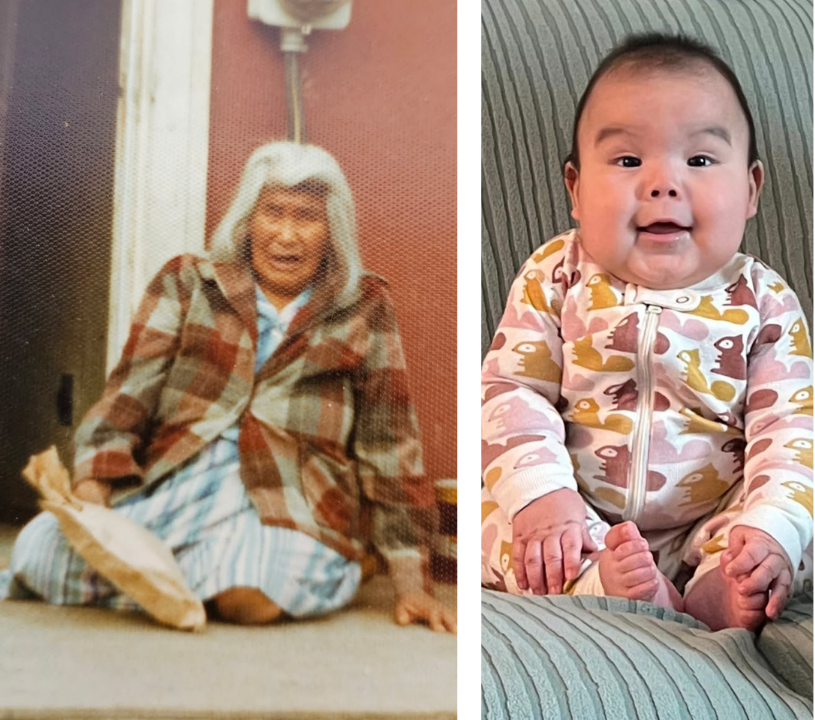
Lena Peter (birthday unknown), Layne Sherry (born 2025)
Lena Peter (birthday unknown), Layne Sherry (born 2025)
By Irene Sherry
Spring 2026, FORUM Magazine
MY GRANDMOTHER WAS BORN in the late 1800s, and I can’t imagine the kind of life she lived. She grew up in small family camps in the Minto Flats in central Alaska, living off the birds, animals, fish, and berries of the land. She spoke only the Minto dialect of the Athabascan language. She was blind, and she used hand motions and facial expressions to communicate with those like me who didn’t speak the language. Her husband was named Minto Peter, or Little Pete; he died before I was born. They were both song makers and story tellers, and their songs are still being sung today by the Minto people.
My mother was born in 1912 in the Minto Flats near Cache in winter camp. She spoke Athabascan but learned English from the missionaries. She never had any formal schooling. She married Walter Titus, who went to school through the third grade, and taught her how to sign her name. They lived in Old Minto on the Tanana River in a log house that my father built. Those were hard times. She lost her first four children at birth, and raised four in the village. In the winter she trapped along with her husband. In the spring they lived in spring camp when the birds returned. She spent every summer at their fishcamp, and raised a big vegetable garden in the back yard. For awhile we lived in Nenana, where my dad was a seasonal railroad worker, and my mom helped out at the St. Marks Mission. She was an artist who made all her own patterns and beadwork. She made all of our clothing. In the 1950s we got our first radio with a big battery and an aerial. That’s how many adults learned to speak English. She passed away in in 1970 after being in the hospital in Anchorage.
I grew up in the village of Old Minto. At age nine I was beginning to learn my Native language when I was unwillingly sent for one year to the Bureau of Indian Affairs boarding school in Wrangell, Alaska. I never fully learned my language after that. I also went to the BIA high school in Sitka, Alaska for four years. This boarding school did teach me about other cultures, and made me want to learn more. I married when I was in my twenties, and we raised four children together in Fairbanks and Anchorage. I worked for social service agencies and at the Alaska Native Medical Center. I received associate degrees in Theology and Rural Human Services. We lived in the new Minto Village for four years where I was the Behavioral Health Aide. Because I wanted to preserve the stories of our village life my husband and I spent two years producing a documentary film.
Over these four generations, some things were lost and things were gained. So incredible is the change in lifestyles between my grandmother and my grandchildren, and the different environments we have lived in.
My daughter was born in Fairbanks and grew up both there and in Anchorage. She graduated from the University of Washington and from the University of Michigan with a Master's degree in Public Policy. She spent two years in the Peace Corps in the South Pacific, and brought her fiancé back to Alaska. They have three girls of Athabascan, Melanesian, and Scot/Irish descent. Today she is an executive vice president of external affairs with our regional land claims corporation, advocating in Washington, D.C. and Juneau.
Our son was born in 1983 and grew up in Fairbanks and Anchorage, with many visits to the village and out to our land, moosehunting, so he knows where we came from. Today he is a union member who works at the Space Force base at Clear Alaska. He is both Athabascan and Scot/Irish, and has a son and two daughters. He is a student of tribal government and wildlife management, and a participant in the restoration of wood bison to the Tanana River Valley. He is building a small cabin on the Chatanika River on the Native allotment where his uncle once trapped.
My first born grandson was born in 2006. He grew up in Fairbanks and Anchorage until his early teens, when he moved to Oklahoma, where he attended high school, and is now in college. He is very bright and inquisitive, and studying journalism and history. He desires to reconnect with his Alaska roots after finishing school.
I have a hard time sharing about myself and my family, because in our Athabascan culture we are taught not to bring attention to ourselves. The reason I am sharing the stories of these lives is because they reveal how much change has happened over 125 years.
Over these four generations, some things were lost and things were gained. So incredible is the change in lifestyles between my grandmother and my grandchildren, and the different environments we have lived in. I am grateful to God for all of the gifts he has given me.
It makes me wonder where and how my youngest grandson Layne, now nine months old, will live in the future. ■
Irene Sherry (2026 FORUM Storytelling Fellow) is an Athabascan woman from the village of Minto Alaska. She is a wife, mother, grandmother, boarding school survivor, film producer, counselor, student mentor, and prayer warrior.
FORUM is a publication of the Alaska Humanities Forum. FORUM aims to increase public understanding of and participation in the humanities. The views expressed by contributors are not necessarily those of the editorial staff or the Alaska Humanities Forum.
The Alaska Humanities Forum is a non-profit, non-partisan organization that designs and facilitates experiences to bridge distance and difference – programming that shares and preserves the stories of people and places across our vast state, and explores what it means to be Alaskan.
September 21, 2026 • Taylor Strelevitz
August 27, 2026 • Eiden Pospisil
July 24, 2026 • Annie Garay