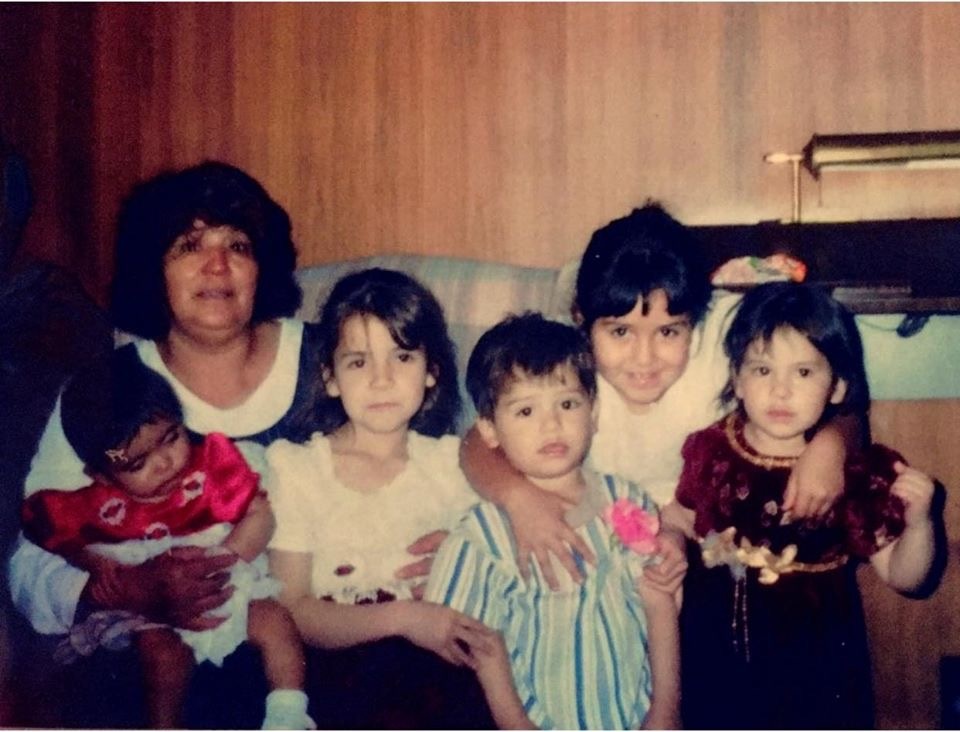
Photo of my siblings and I circa 1997, my uncle took us in despite knowing what the future held for us. Photo courtesy of Elizabeth Pantaleone.
Photo of my siblings and I circa 1997, my uncle took us in despite knowing what the future held for us. Photo courtesy of Elizabeth Pantaleone.
By Elizabeth Pantaleone
Spring 2026, FORUM Magazine
GROCERY SHOPPING WITH A TODDLER and a preschooler can be difficult, wrangling them both out of the car. Ensuring I'm ready to chase if it comes to that. My children love the themed carts you find at the Carrs grocery: the firetruck, taxi, and police car all lined up at the entrance.
I sometimes struggle to get them in, my son repeating, “Put me in, mama, put me in,” as I strap his sister in place. My cheeks are rushing red from embarrassment, trying to reassure him that I hear him and I’ll help as soon as I can. That’s when a man came up and spoke to my son. My first reaction was to be on the defense, but he just quickly lifted my son up and into the cart, spoke kind words, and walked away.
It was the most helpful thing I needed at that moment, allowing me to walk around the store with ease. At some point, he stopped in passing, “I’m so sorry if that was out of line,” I tried to reassure him in such a short interaction, that what he did was Godsend in that moment. But all I could say was “oh no, it’s okay,” before quickly parting ways.
Afterwards there was a desire to tell him how much he helped, how grateful I was that he did, despite current social norms. Social norms that tell us helping others can be seen as rude, condescending, or seen as an inconvenience.
In November of 2025, my in-laws experienced a devastating house fire; they watched as their hard work and memories were engulfed in flames. The following weeks were grim; the realization that we couldn’t drive to their house on a regular weeknight would hit like bricks to the face more times than I’d like to admit. They were at a point in their life where they were picking up the pieces and needing community support more than ever. When they should have been planning for retirement, they were figuring out how to rebuild their lives. As I look back on those six months, I think of all the emotions overflowing like a bathtub as you step too quickly into it.
When it happened, I selfishly thought about my own memories and things that lived there after we moved out. The first home my son had ever known, the place where I was able to transition into motherhood. I thought about first birthdays, holidays, and those random weeknight dinners together with people who cherished my children the way I did.
Despite the season of life they were in, my in-laws remained involved, offering to do day care drop-offs on busy mornings or inviting us to their rental for dinner. My mother-in-law, despite her grief, put on Christmas at a temporary home that still felt homey. Not because of the decorations or the Christmas tree, but because of the love that radiated off her and the rest of the family.

Our son in the first home he had ever known — a place of love and acceptance. Photo credit: Elizabeth Pantaleone
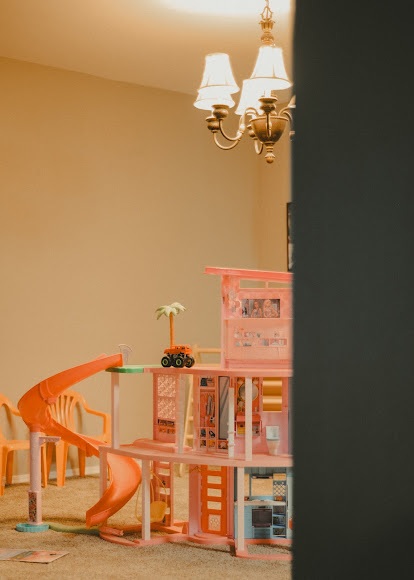
Temporary playroom set up by my mother-in-law to make my children feel welcomed in a new place. Photo credit: Elizabeth Pantaleone
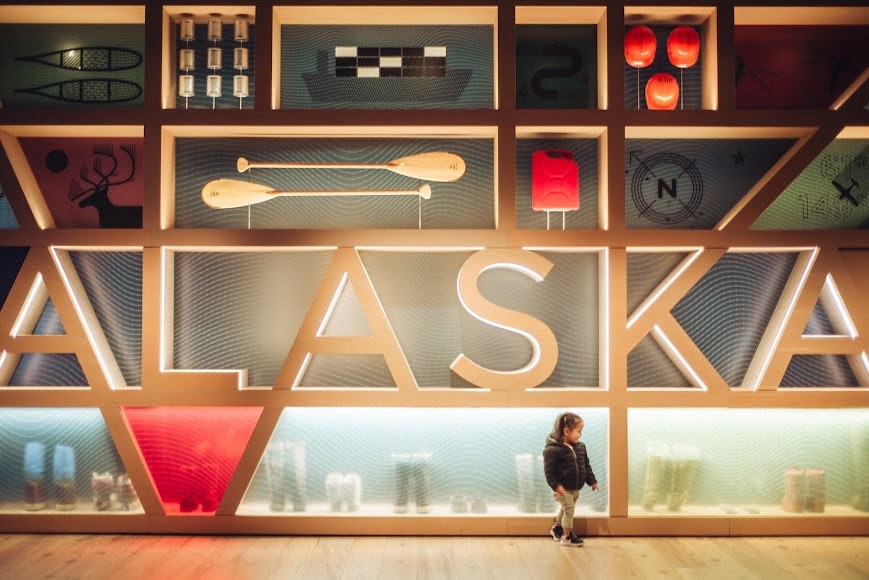
My daughter at the Anchorage Museum, a reminder of all Alaska has to offer in terms of art and community. Photo credit: Elizabeth Pantaleone
I saw my sisters and their families pitch in to replace clothing or things that would have made my mother-in-law feel more at home. I saw my brothers-in-law and their families do the planning, organizing, and taking in my father-in-law the night the fire occurred, since he was the only one in town. It was reminiscent of my aunts and uncles providing support to one another in moments of crisis. My uncle flying down to Texas after the death of my mother, bringing all five of her children with him despite not having a plan. Although moments like these bring me hope, I can’t help but wonder about those without that system.
Parents with disengaged grandparents or grandparents whose kids and grandkids are busy, making it difficult to plan. I think about those who travel to Alaska because of military placement or the fishing/oil industries. Some of them come because of a friend, but most have no one other than their spouse or co-workers. How difficult it can be to extend invites to others while fighting the feeling of being seen as inconvenient, pushy, or needy.
Wondering when the shift from community to individuality came, was it the popularization and misuse of common therapy speak? The personal “let them,” mentality, and the need for rigid boundaries without talking and addressing things. Furthering the me against them, hindering the development of a village or community. Or was it the global pandemic, forcing individuals to decrease those in their bubble, in order to keep others safe? The services that came with it, making it convenient to minimize social interactions, that are no longer helping in the same way.
The only thing that has worked for me is the reminder that the price of community is inconvenience.
Or is it the current economy? Requiring both parents and grandparents to work, sometimes multiple jobs, with little time to enjoy their families and friends. The young adult who’s just trying to afford groceries, and any extra time they have is dedicated to a side hustle to supplement rent money.
It seems like a variety of things, and solutions aren’t always one size fits all. The only thing that has worked for me is the reminder that the price of community is inconvenience. To say “yes, I can help,” when you’d rather spend time at home or doing literally anything else. It’s doing things not because you get something out of it but because you truly care about the person you’re helping. It’s also having difficult conversations even when you’re feeling ashamed, angry, or sad.
My in-laws are planning to have their house demolished this fall, and a tidal wave of emotions are expected to follow, like seeing the fire occur all over again. I’m sure we will be there, not physically, but emotionally. We’ll be there because we know they would do the same, no push back or complaining.
I recently read a poem entitled All at Once by Clint Smith during my trip to the Museum of Modern Art in San Francisco, California. A summary of the poem is this, in a world full of tragedy, whether that be a natural disaster, a worldwide pandemic, or a war happening across the sea — there is beauty and hope happening all at once. When I was younger it was harder for me to focus on the latter of the two. The concept of individualism was heavy on my soul, that if I wanted to be seen as successful then I would need to dedicate my time and energy in a higher job title, more pay, and forgo the idea of having a family.
That concept still spills into my mind when comparing myself to others, but now it’s easier to push away. As I continue to grow in every capacity, and reflect on my journey, my family and community have always been there. To have found something so grounding and integral to inner healing is a blessing and so clearly common in Alaska and our communities. ■
Elizabeth Pantaleone (2026 FORUM Storytelling Fellow) is a life-long Alaskan, passionate about advocating for the increase of quality childcare and early childhood education in her community. She holds a Master of Science in Clinical Psychology and Graduate Certificate from the University of Alaska Anchorage. She holds a Bachelor of Arts in Psychology with minors in early childhood development and philosophy from Cal Poly Humboldt (formally Humboldt State University). Elizabeth is currently an Early HeadStart Coach, supporting teachers in strengthening instructional practices through Conscious Discipline training and CLASS observations. Elizabeth started a personal photography project Dember 2025 entitled "Through Their Eyes: Alaska" focusing on the untold stories of Anchorage's childcare crises through interviews accompanied by portraits. Through this writing fellowship, Elizabeth aims to highlight the successes and challenges of early childhood education in Alaska. Raising awareness about the essential role early childhood care and education plays in Alaska's economy, the struggles educators and families are facing and a look forward in search for hope.
FORUM is a publication of the Alaska Humanities Forum. FORUM aims to increase public understanding of and participation in the humanities. The views expressed by contributors are not necessarily those of the editorial staff or the Alaska Humanities Forum.
The Alaska Humanities Forum is a non-profit, non-partisan organization that designs and facilitates experiences to bridge distance and difference – programming that shares and preserves the stories of people and places across our vast state, and explores what it means to be Alaskan.

September 21, 2026 • Taylor Strelevitz
August 27, 2026 • Eiden Pospisil
July 24, 2026 • Annie Garay
