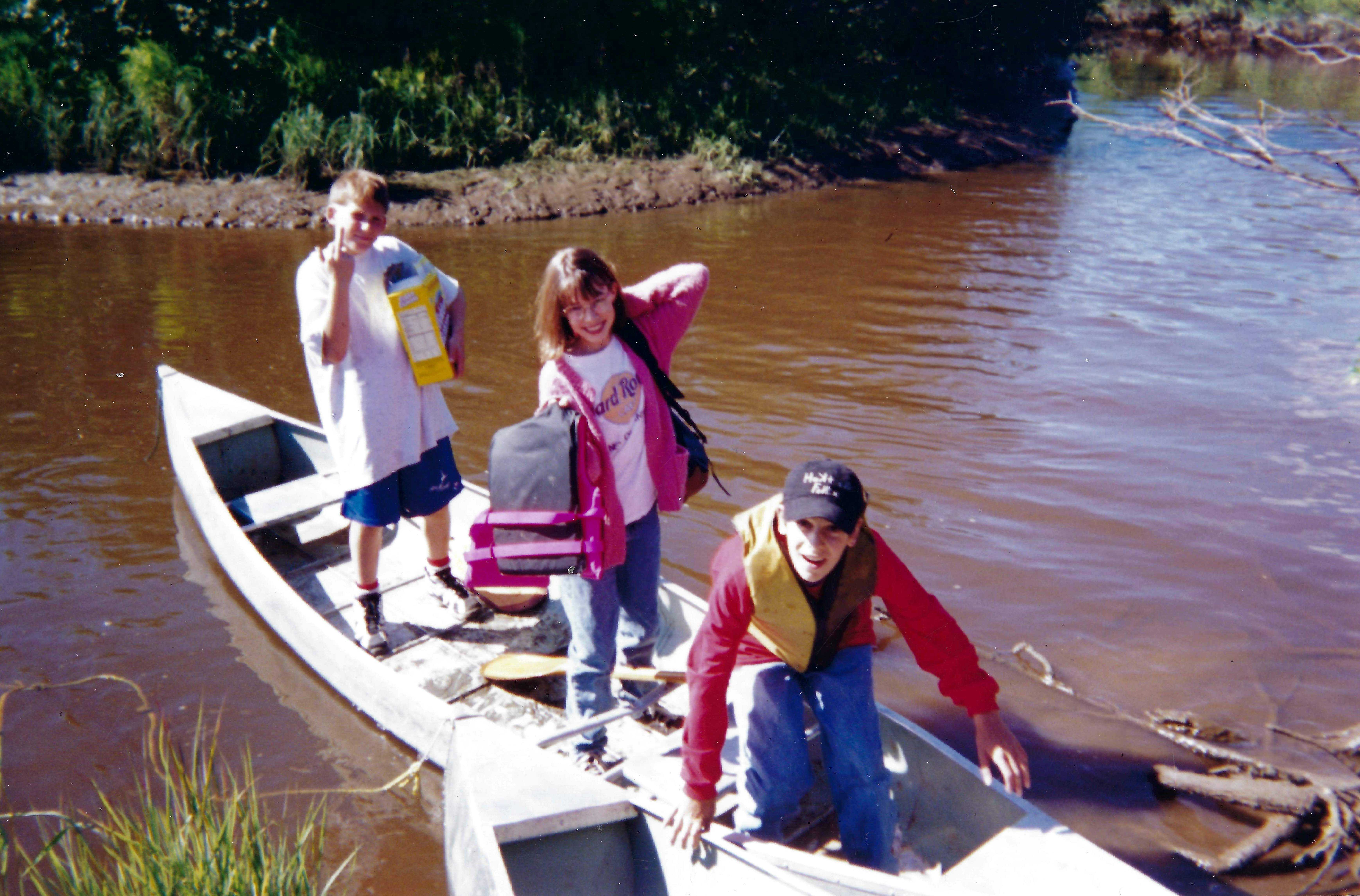
Canoeing in Brown’s Slough with Drake and Andy. Summer 1995. Courtesy of Katie Basile.
Canoeing in Brown’s Slough with Drake and Andy. Summer 1995. Courtesy of Katie Basile.
By Katie Baldwin Basile
To read additional excerpts from Katie's interview with Fran Reich, click here.
Spring 2025, FORUM Magazine
I RIDE DOWN MAIN STREET on my bicycle, half rust and half purple with pink lettering. Take a right at the stop sign onto 6th Ave and stand up high on the pedals. It’s cloudy, the 50-degree air is cool against my sweaty forehead and as I pump my legs the wind picks up. The dust is settled by this morning’s rain, at least for now. It’s 1995, I’m twelve and my pockets are full of ten-cent candy from I.D. Variety.
(Sidebar Ode to I.D. Variety: The jingle of the door, the smell of gerbils in sawdust, and the cackle caw of a parakeet. An assault on the senses, all worth it for the rickety, rotating display of tootsie rolls, smarties, starbursts, and dum-dums at ten for a dollar.)
With a cascade of refined sugar funneling into my bloodstream, I am ready for a summer afternoon playing softball in the street with the neighborhood boys. As I write this, I feel like I’m describing a scene from 1950’s middle America. White picket fences, a mom in a checkered apron, and sidewalks lining the paved streets. But this is Bethel, Alaska, 400 miles from the nearest sidewalk. Sixth Avenue is a dirt road and the ditch next to it floods with water twice a day when the tide rolls in.
“Welcome to Alligator Acres,” is scrawled on a dumpster near my parents’ house in peeling paint. Our neighborhood’s name reflects the marshy wetland it sits upon. While we don’t have alligators, at certain times of year this place could easily be mistaken for a Louisiana bayou.
Bethel sprawls across 48 square miles of tundra with a mixture of paved highway, dirt roads, and neighborhood subdivisions. Alligator Acres is on the far eastern end, sloping in the direction of ‘upriver’. Our houses are built on stilts, both to ease the chore of leveling buildings when the permafrost shifts and to appease the 100-year flood line insurance policy requirement. A slow-moving stream of muddy water called ‘Brown’s Slough’ winds behind our homes. The slough is named not for its muddy color or the city sewage that’s released into it twice a year, but after the Browns, one of Bethel’s original families.
Alligator Acres is a parallel universe. A suburban neighborhood floating precariously on the tundra. A scene-setter from “Leave it to Beaver” corrupted by the reality of thawing permafrost. A page from a Dick and Jane reader, overburdened by a generation of good folk who saw the value in everything and decided to keep all of it, forever.
Our neighbors' yards overflow with broken-down cars, stacks of window frames, gill nets, boats, snow machines, four-wheelers, sheets of insulation, and more. We live off the road system and therefore rely on airplanes and barges for all our supplies. The yards of our neighbors are the physical manifestations of the questions in everyone’s subconscious, “What if the last shipment doesn’t come? What if they never make this snowmachine part again? What if we run out of cars? What if the rest of the world forgets about us?”
It’s summer and this is swampland. The mosquitos breed at the base of the willow brush, and no amount of repellent can discourage them from feasting on me. So, I ride faster. Right into the make-believe baseball diamond that’s set up on the street in front of my friend Jacques’ house.
I park my bike. There’s my older brother Jamie with his mess of curly hair, Andy with his Pearl Jam obsession and mouth full of braces and Jacques who towers over the rest of us at 6-foot-one. Byron is here but he’d rather be on his skateboard if the dirt and gravel road would allow it. The three Fairbanks brothers show up last: Zach, Drake, and Seth with shit-eating grins and a pair of crutches. I don’t remember who was injured at that time, their chaotic nature often led to accidents, and it was hard to keep track of who had suffered the latest spill.
Green Day plays on the stereo sitting on Jacques' front steps.
I’m terrible at softball. I am glasses, braces, skin, and bones. Eventually, it’s my turn to bat and I strike out immediately. But I don’t care. Belonging is a vital and tenuous thing at age twelve and geography is on my side. To be here on this street, with these guys, that’s my whole world.
We hear the distant rumble of a four-wheeler. The road is drying out now and a cloud of dust announces the arrival of Fran Reich. We pause the game for a minute as he throws a few cardboard boxes in the dumpster. Fran is originally from West Virginia, dyes his hair blonde, and runs sled dogs. Back in the 1970s he bought this plot of marsh and tundra and developed the neighborhood. He’s got a teasing, mischievous sense of humor that usually leads to pranks and scuffles with us, the neighborhood kids.
“Hiiiii Francois,” Drake croons. Fran snickers, jumps back on his four-wheeler and rides down to his corner compound.
Jamie steals my Starburst. Zach distracts us all with a near perfect Adam Sandler monologue. “Stop looking at me swan!” he says, mimicking a scene from the movie Billy Madison and we howl with laughter. Jacques rolls his eyes and the game devolves.
By the end of that summer, the dynamic shifted. Our neighborhood gang grew with a few regulars biking across town by way of the rolling trail that runs alongside the Kuskokwim. We still played softball in the street, but we also smoked cigarettes under our parent’s houses and snuck vodka from their liquor cabinets. Our parents were all friends with each other. The phone tree was active, and they caught us when they could — but out here, surrounded by open space, we got away with more than we should have.
The change was inevitable and in some ways, I reveled in it. There is a bond that forms between friends who break rules together, a quiet understanding that tightens over shared secrets. Still, part of me missed the safety of rule-following, the simplicity of just riding my bike down Sixth Avenue with nothing but sugar in my veins and the Bethel wind in my hair.
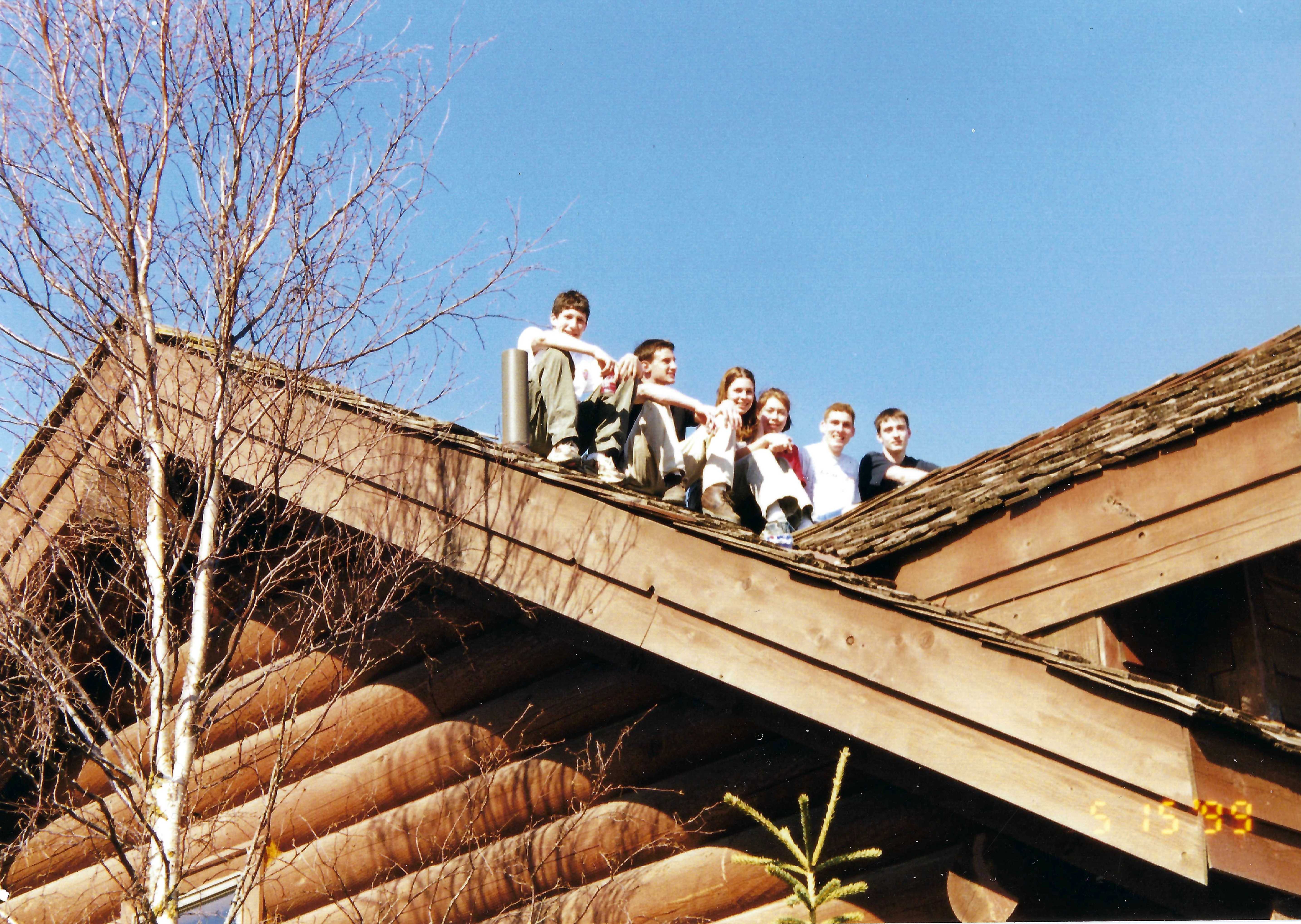
Sneaking onto Angstman’s roof during a graduation party for the older neighborhood boys. Spring 1999. Courtesy of Katie Basile.
The Hamptons of Bethel
Around that time, I heard someone call Alligator Acres the “Hamptons of Bethel.” I had no idea what the Hamptons were — there was no Google yet. But I got the sense that it meant something fancy — probably elitist.
It occurred to me that despite the junk piled up in my neighbors’ yards and the clouds of dust and mosquitoes — despite the fact that we were born to public school teachers, nurses and homesteaders, Alligator Acres was known as a place of privilege. In a town often defined by poverty statistics, there was no denying that we were well provided for. Our neighborhood boasted many homes that were 1700 square feet or even bigger. We enjoyed running water, flushing toilets, kitchen cupboards full of store-bought food and an array of mostly working vehicles. My family flew back to Oregon regularly to see our extended relatives, undeterred by the $300 roundtrip airfare required to leave Bethel and join the road system.
Furthermore, I took a good look around at my neighbors and for the most part, we were white. Before the missionaries called our town Bethel, it was named Mammterilleq and it always has been and always will be a Native community — a Yup’ik community. And nobody in Bethel, Alaska wanted to be a scrawny, middle class white kid. Including me.
The Yup’ik communities I grew-up in are rich in family connection, good humor, food sourced right from the land and an Indigenous language that reflects the geography, climate and value of strong familial roles and relationships. Two of my Yup’ik friends called each other “lungi” short for “ilungapak” which I understood to mean “best-friend, cousin, sister, relation”. A name that bestowed a real sense of identity and belonging. I saw that bond from the outside and I wanted in.
At twelve my natural state was pure Dork. I was the nerdy sidekick in every 90s after school sitcom — glasses, braces, and a tragic middle part. Sometimes, I wanted to shove that awkward girl into Brown’s slough and leave her there forever. By the age of fourteen, I wanted to belong so desperately that all it really took was a friend giving me a sideways look to get me to sneak out of my parents’ house and throw back some Gilbey’s Vodka with a Strawberry Crush chaser. Even though I knew better.
When many nearby communities went ‘dry’ outlawing the sale of alcohol completely, Bethel elected the murky mandate of ‘damp’ which meant that you could ship alcohol in from Anchorage, but nobody could legally sell it. This creates a situation where bootleggers make up to $100 a bottle, booze is readily available to teenagers and fake IDs aren't required.
Belonging is a vital and tenuous thing at age twelve and geography is on my side. To be here on this street, with these guys, that’s my whole world.
Instincts often come in the form of a physical sensation, a dropping feeling in the gut, a tightness in the chest and an urge to turn away and move in the opposite direction. My instincts always told me to follow the rules. My ability to disregard those instincts started with peer pressure but eventually the social persuasion was replaced by an adrenaline rush so intoxicating I can still feel my heart rate pick up as I recall the sneak out system my best friend Jamie and I perfected over time.
We waited in the dark, looking out my bedroom window until we saw a car pull up to the dumpster down the street. Once it was parked, we flickered my light on and off a few times. If the car flickered their headlight back at us, we knew it was time to go. From there we would tiptoe down the stairs carrying our shoes. My parents had big living room windows that opened like doors onto our deck. Opening the front door was noisy and would turn on the motion sensor light, so we climbed out one of the big windows, down the back stairs, around the house and into the driveway. This was the trickiest part — my parents’ bedroom faced the street. Every decibel over absolute silence put us at risk so we sacrificed our dry socks and sprinted stocking-footed down the road with our eyes locked on the dumpster where a friend waited in a running car.
Our feet padded lightly on the frosted dirt road, careful to avoid puddles covered in thin shells of overnight ice. Sleeves pulled low over our hands, gripping our sneakers. A dog’s bark from a nearby house startled us, urging us on to our destination: a flatbed, a Bronco, an old, red extended cab pick-up.
There was a moment when my sleeve-covered palm touched the car door handle, where one world would become another. From the dark, cold, quiet tension of our sprint, we stepped into a portal, a warp zone, and finally, an exhale as I pulled the handle open. A blast of warm air hit us, thick with Swisher Sweet smoke, faces glowing under the dome light, Metallica bellowing from the speakers. We’d hop in and drive off — out of Alligator Acres and into the night.
We usually made it home no problem. A backwards dance of the sneak out system, dumpster drop off, shoes in hand, quiet sprint back and around the house. A gentle push on the window and back upstairs where we’d lay down, safe, giggling, happy we’d pulled it off yet again.
One Saturday night we’d successfully snuck out and made our way to Blueberry Subdivision where our friend was hosting a party in his garage while his parents were out of town. We were giggling over some Miller High Life when we heard a knock at the door. Before we could hide the beer, Grant and Debbie Fairbanks walked in to collect Zach, Drake and Seth. Where my parents would be horrified, Grant and Debbie took this all-in stride. Grant grinned at us, grabbed a cigarette out of Zach’s hand and took a drag before crumpling it under his boot. I was still looking for a place to hide when Debbie spotted me.
“Oh, look Katie Baldwin’s here too. You are all coming with us,” she said, clearly amused.
She proceeded to explain that they’d driven by my house earlier that night and saw us flickering my light on and off. Their oldest daughter Cheska was home from college and commented that we must be sneaking out. Little did we know that our discreet light flicker strategy was apparently a pre-cell phone universal teenage code that means, pick me up I’m ready to party.
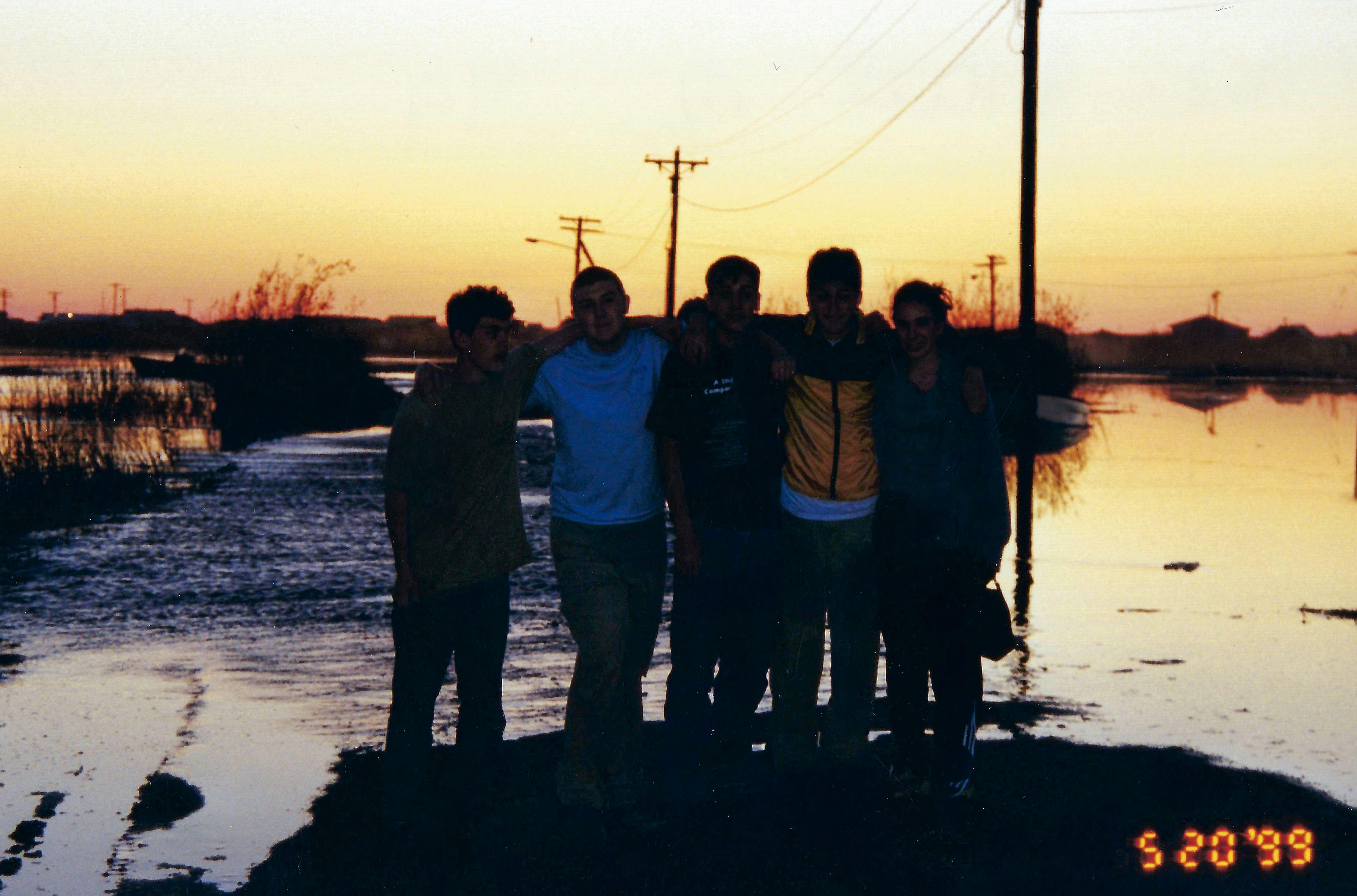
Ice jams cause the Kuskokwim River to overflow into town. Spring 1999. Courtesy of Katie Basile.
“Are you going to tell my parents?” I asked.
Debbie laughed hysterically and said rather gleefully, “You bet we are!”
I’d made it out of Alligator Acres only to get caught by the neighborhood guard and dumped unceremoniously back home. We paid the price the next morning, but the real learning comes years later as I recognize a pattern that seems to define my life. I’ve tried to sneak my way out of this neighborhood so many times, but it always pulls me back.
At that age, my greatest fear was getting caught by my parents. I was oblivious, or maybe in denial, to the real dangers that lurk out there. Now I am all too aware that danger is never just one thing, but a combination of factors that I’ve seen play out over and over again. Alcohol and subzero temperatures. Boats, snowmachines and the teenage perception of invincibility. Lecherous men, underage girls, shop parties. And the tiny tablets of OxyContin that led too many of my peers on a shattering, lifelong quest for dopamine hits.
Thirty years later I walk down the street and see the ghosts of us. The guys all left, in one way or another. I left too, for a long time. By the end of high school, Bethel felt so small and suffocating and I ran — first to Montana, then Prague, then New York, then Oregon. But something about this place never let me go and a desire to understand it grew within me. There is a closeness here that I can’t find anywhere else. And there is a comfort in knowing that this land will provide, this community will rally around a good idea and even the person who annoys you the most will have your back when it really matters.
Slowly, I was pulled back west, back to the tundra, back to Alligator Acres. Now I live 174 feet from the house I grew up in, watching my own two sons ride these same dirt roads, the cycle looping back on itself.
A Powerful Vision
Fran had small children when he arrived in Bethel and first had the idea to build this neighborhood. When I asked about his dream, he told me:
“I wanted desperately to have a place for them. I was overwhelmed with this urge to build a community that could encompass a whole lot of people who liked each other and enjoyed a way of life. And that vision was a powerful vision.”
Tonight, Fran’s wife Julie is hosting the annual neighborhood lantern walk on the same streets where I pedaled my rusty purple bike so many years ago. The ceremony is sweet, simple and grounding. We light lanterns, walk through Alligator Acres singing songs and gather around a bonfire for hot drinks — symbolically bringing light into the community during the darkest part of fall.
We begin as we always do. With Julie realizing that she forgot to look up the lyrics to the songs and we giggle as we leave their driveway repeating the only lines anybody knows.
“This little light of mine, I’m gonna let it shine…”
As we walk, I think back to that little girl on the bike. And then to the teenager sneaking out, chasing adrenaline, seeking connection.
My boys are young. They sing the lantern song earnestly. Someday that will change. They will follow that pull toward belonging, wherever it leads. As a parent you hope they find their way back again and you do what you can to guide them. But control is an illusion, no matter where you live.
So I give them what Fran once hoped to give his children — a place, a neighborhood, a community to come back to.
We turn the corner onto 6th Avenue, still repeating the same lines over and over again. My boys run ahead with the older kids, their lanterns bobbing in the dark.
And I let them go. ■
Katie Baldwin Basile is a documentary photographer and multimedia storyteller from Bethel, Alaska. She lives in Alligator Acres with her family.
FORUM is a publication of the Alaska Humanities Forum. FORUM aims to increase public understanding of and participation in the humanities. The views expressed by contributors are not necessarily those of the editorial staff or the Alaska Humanities Forum.
The Alaska Humanities Forum is a non-profit, non-partisan organization that designs and facilitates experiences to bridge distance and difference – programming that shares and preserves the stories of people and places across our vast state, and explores what it means to be Alaskan.

July 24, 2026 • Annie Garay
July 23, 2026 • Taylor Strelevitz & Polly Carr
July 17, 2026 • Polly Carr